Quick answer: A working wooden garden gate normally needs a suitable pair of hinges and a latch. Depending on the latch, it may also need a separate handle. Add a bolt, hasp and staple or other security fitting only where the job requires it. Every fitting must be fixed into solid gate framing and supported by a suitable gate post.
Gate hardware is easier to choose when each product is given one clear job. Hinges carry the gate. The latch holds it closed during normal use. The handle gives you something to grip. A bolt adds restraint. A locking fitting provides additional security. Buying several pieces that all look like gate hardware does not guarantee that they form a complete working system.
The five jobs gate hardware can perform
| Job | Typical product | Always required? |
|---|---|---|
| Carry and pivot the gate | Tee hinges or hook and band hinges | Yes |
| Hold the gate closed | Suffolk, ring or automatic latch | Normally |
| Provide a hand grip | Built-in latch handle or separate pull handle | Where the latch does not provide one |
| Add restraint | Tower, Brenton or spring-loaded bolt | Only where needed |
| Add locking security | Suitable hasp and staple or confirmed lockable fitting | Only where needed |
Step 1: Check the gate and post before buying hardware
No hinge or latch can compensate for a gate that is badly built or a post that moves. Before selecting the fittings, check:
- The gate width, height and approximate weight
- The position of the horizontal ledges and diagonal brace
- The timber thickness available for fixings
- The gate-post size, condition and stability
- The intended opening direction
- The clearance above the ground and beside the post
- Whether the gate must open from one side or both sides
When building the gate itself, use our beginner-friendly ledge and brace gate guide before choosing the final fitting positions.
Step 2: Choose tee hinges or hook and band hinges
Tee hinges are a simple surface-mounted option. Our Eliza Tinsley range is divided into Light Tee Hinges, Medium Tee Hinges and Heavy Tee Hinges. This makes it easier to select the duty range before choosing the individual length and finish.
Hook and band hinges use a long band on the gate and a separate hook on the post or frame. The Straight Band & Hooks On Plate Pair provides a matched two-part arrangement for a traditional timber gate.
Whichever type you choose, position the hinges over solid ledges or framing and use compatible fixings. Read the full tee hinge vs hook and band guide before ordering.
Step 3: Choose how the gate will open
The latch choice determines whether the gate already has a handle:
- Suffolk latch: thumb-operated and includes its own traditional handle. See the Suffolk Latch with Long Thumb Bit.
- Ring gate latch: operated by a ring handle and can provide a grip on the gate faces. Choose the plain Ring Gate Latch or Twisted Ring Gate Latch.
- Automatic gate latch: catches when the gate reaches the closed position but does not include a handle. Pair the Automatic Gate Latch with a separate Pull Handle where a hand grip is required.
An automatic latch does not close the gate by itself. It only catches when the gate and keeper meet. Compare all three options in our gate latch guide.
Step 4: Decide whether the gate also needs a bolt
A latch is normally used each time the gate opens. A bolt is often additional: it can hold the gate more firmly when not in use or secure the inactive leaf of a suitable double arrangement.
- Choose a Tower Bolt for a simple compact slide bolt.
- Choose a Brenton Bolt for a larger traditional gate bolt.
- Choose a Spring Loaded Bolt when spring pressure is useful for maintaining engagement.
Read the tower bolt vs Brenton bolt vs spring-loaded bolt guide for the full comparison.
Step 5: Add security only where it is needed
A normal gate latch is not automatically a lock. A simple bolt is not automatically suitable for a padlock either.
Where the gate needs padlock-based security, a Hasp & Staple gives that function clearly. Check that the timber, fixings, padlock and access arrangement are all suitable. Remember that the security of the complete gate is limited by the gate boards, frame, post and exposed fixings as well as the locking product.
Step 6: Check the fixings and fitting positions
Lay the hardware against the gate before drilling. Check that every screw or bolt enters solid material and that moving parts clear the gate frame throughout the swing.
Pay particular attention to:
- Hinge arms landing over the gate ledges
- Latch spindles or thumb bars passing through suitable material
- The latch keeper aligning without lifting or pulling the gate sideways
- Bolt keepers being positioned only after the gate is hanging correctly
- Fixings being compatible with the hardware, timber and exposure
- Black and galvanised finishes being selected consistently where appearance matters
Which hardware combination suits your gate?
| Gate or door | Hinge starting point | Latch starting point | Possible extra |
|---|---|---|---|
| Small, light timber gate or shed door | Light tee hinges where suitable | Suffolk or automatic latch | Pull handle with automatic latch |
| Typical framed garden or side gate | Medium or heavy tee hinges, or hook and band hinges | Ring or Suffolk latch | Tower or Brenton bolt |
| Traditional substantial timber gate | Heavy tee hinges or hook and band hinges after checking the complete installation | Ring latch | Brenton bolt or suitable locking fitting |
| Gate that should catch when pushed shut | Suitable tee or hook and band hinges | Automatic gate latch | Separate pull handle |
| Inactive leaf of a suitable double arrangement | Hinges selected for that leaf | Main latch on active leaf | Vertical tower or spring-loaded bolt where suitable |
This table provides a starting point rather than a structural rating. An unusually wide, heavy, exposed or high-value gate needs the complete gate, posts and hardware assessed together.
Are complete gate sets easier?
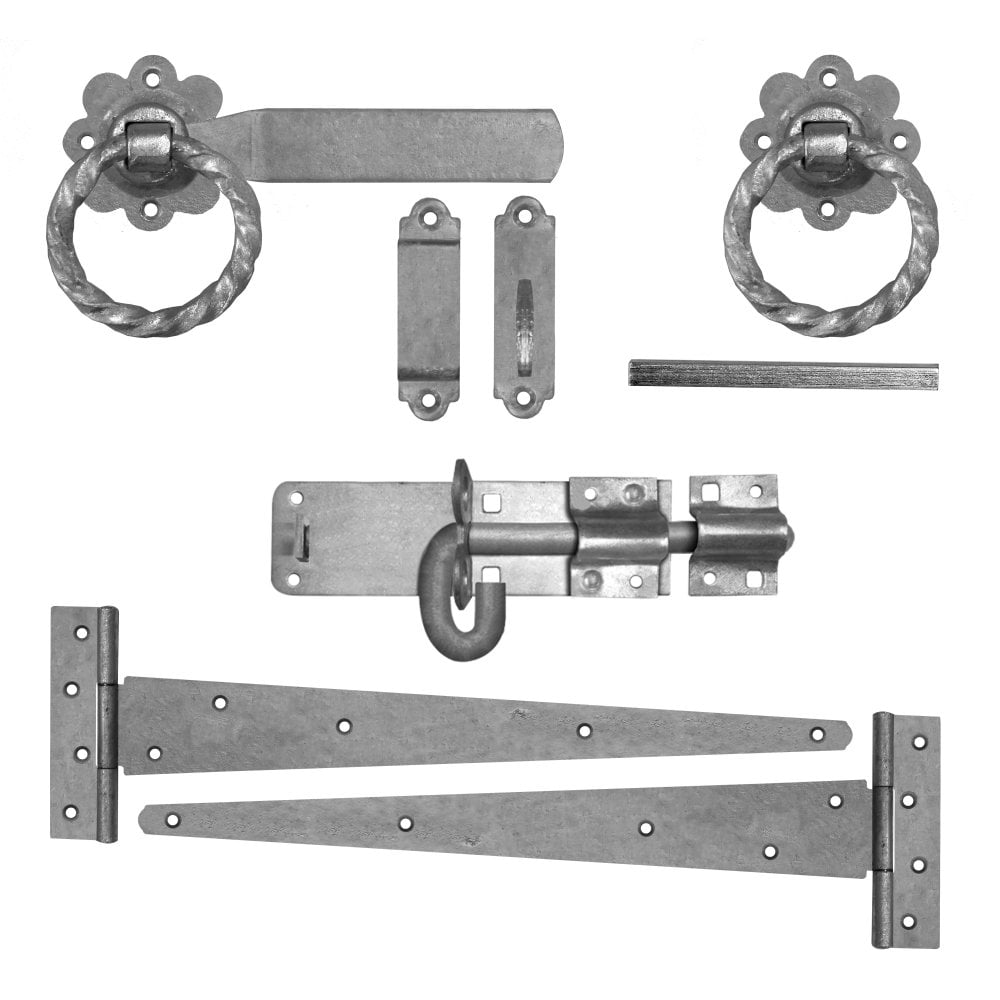
A gate set can remove some of the uncertainty by combining matching hardware in one pack. Our Eliza Tinsley range includes Gate Set A, containing heavy tee hinges, a Brenton bolt and a twisted ring latch, and Gate Set D, containing tee hinges and a plain ring latch.
A set is only the easier option when its hinge size, latch style, finish and included parts suit the actual gate. Check the product contents rather than assuming every gate set fits every garden gate.
Before you order
- Measure the gate and identify its solid ledges or frame.
- Check the post is stable and suitable for the hinge fixings.
- Choose the hinge type and duty range before choosing length.
- Decide whether the gate must open from one side or both.
- Confirm whether the latch includes a handle.
- Add a bolt only when it has a specific job.
- Add a locking fitting where genuine security is required.
- Check all included and separately required fixings.
- Confirm the finish and quantity before ordering.
Shop wooden gate hardware
Browse our full gate hardware and ironmongery range, including hinges, latches, bolts, handles, complete gate sets and timber gates. Use the linked comparison guides above to narrow the choice before placing the order.