Plasterboard Looks the Same Until You Put the Wrong Board in the Wrong Room
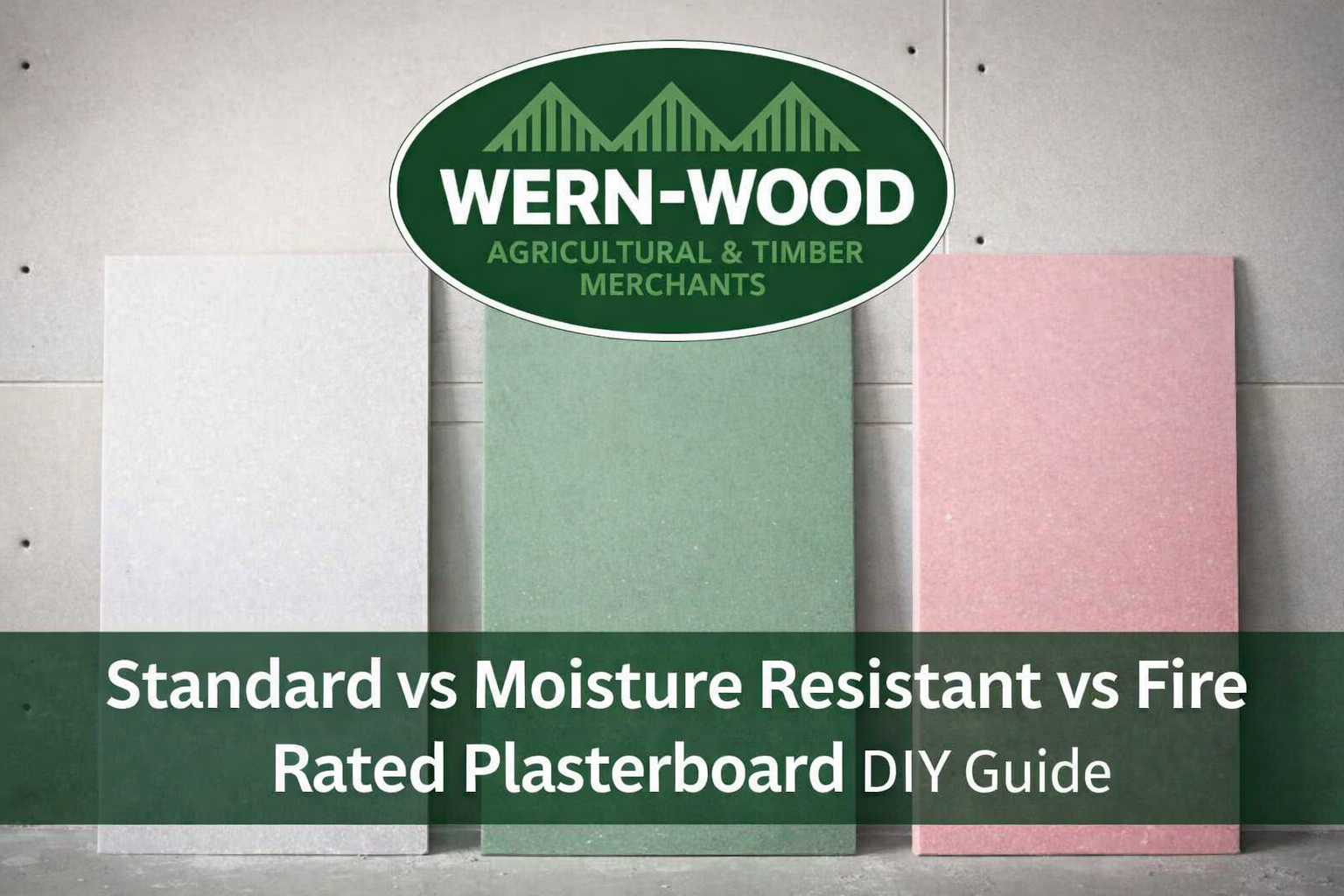
Use standard plasterboard for most dry internal walls and ceilings. Use moisture resistant plasterboard in humid internal rooms such as bathrooms, kitchens, cloakrooms and utility rooms, but do not treat it as waterproof in direct water zones. Use fire rated plasterboard where enhanced fire performance is required, but remember that fire resistance comes from the full system: board type, thickness, layers, fixings, framing, joints and penetrations. The board alone does not make a wall waterproof or fireproof.
Plasterboard is easy to underestimate. From a distance, one sheet can look much like another. Then the room changes the rules.
A dry bedroom wall, a steamy bathroom ceiling, a garage conversion and a fire-rated partition are not the same job. Standard board, moisture resistant board and fire rated board all have a place, but they should not be treated as interchangeable.
The best way to choose plasterboard is simple: start with the room, then the risk, then the finish. Is the area dry, humid, exposed to direct water, or expected to provide fire performance?
Quick comparison: which plasterboard should you use?
Use this table as the fast decision guide. It does not replace a specification where Building Regulations or a tested system apply, but it will stop the most common DIY buying mistakes.
| Board type | Best for | Do not use it for |
|---|---|---|
| Standard plasterboard | Dry internal walls, ceilings, partitions, repairs and general room lining. | Bathrooms, shower rooms, direct water zones or areas needing enhanced fire performance. |
| Moisture resistant plasterboard | Humid internal areas such as bathrooms, kitchens, utility rooms, cloakrooms and condensation-prone ceilings. | Direct or continuous water exposure unless protected by the correct waterproofing/tanking and finishing system. |
| Fire rated plasterboard | Walls and ceilings where improved fire performance is required as part of a complete system. | Assuming the board alone makes a room, garage, wall or ceiling fireproof. |
| Insulated plasterboard | Cold internal walls, renovation projects and thermal upgrade work where suitable. | Choosing without checking wall build-up, condensation risk, fixing method and thermal requirements. |
For the full category, start with Plasterboards & Plaster. Wern-Wood’s plasterboard and plaster range covers internal walls, ceilings, partitions, drylining, skimming, patching and finishing work across domestic and light commercial interiors.
Standard plasterboard: best for dry internal rooms
Standard plasterboard, often called wallboard, is the everyday choice for dry internal walls and ceilings. It is suitable for general internal applications where extra moisture resistance or fire performance is not required.
Wern-Wood’s standard square edge plasterboard is suitable for internal partitions, wall linings, ceilings and general interior building projects. Browse Standard Plasterboard.
Good projects for standard plasterboard
- Bedroom walls
- Living room walls
- Hallways and landings
- Dry ceilings
- Stud partitions
- Boxing-in dry pipework
- Patch repairs
Standard board is usually the simplest and most cost-effective option for normal dry rooms. The mistake is using it where the room conditions are not normal and dry.
Do not use standard plasterboard just because it is cheaper if the wall or ceiling is going into a bathroom, shower room, damp utility area or fire-performance build-up. The room decides the board.
Moisture resistant plasterboard: best for humid internal rooms
Moisture resistant plasterboard is designed for internal areas where humidity and condensation are more likely. The board usually contains moisture-repellent additives in the core and is used in areas such as bathrooms, kitchens, utility rooms and humid internal linings.
Wern-Wood’s moisture resistant tapered edge plasterboard is listed for kitchens, utility rooms, bathrooms and shower rooms excluding direct water contact areas, plus internal partitions, wall linings and ceilings in humid environments. Browse Moisture Resistant Plasterboard.
Good projects for moisture resistant plasterboard
- Bathroom ceilings
- Kitchen walls
- Utility rooms
- Cloakrooms
- Condensation-prone ceilings
- Humid internal partitions
The important wording is “moisture resistant”, not “waterproof”. Moisture resistant plasterboard is useful in humid internal spaces, but it is not a complete waterproofing system.
Moisture resistant plasterboard is not suitable for direct or continuous water exposure on its own. Shower enclosures, wet-room zones and direct splash areas may need suitable tanking, waterproof boards, compatible adhesives, finishes and installation details.
Fire rated plasterboard: best where fire performance is specified
Fire rated plasterboard is designed to provide improved fire resistance compared with standard plasterboard. It is commonly used where a wall or ceiling needs enhanced fire performance, such as garage conversions, some ceilings, separating elements, service areas or specified fire-rated partitions.
Wern-Wood’s fire resistant square edge plasterboard is designed for internal applications where enhanced fire performance is required, including partitions, wall linings and ceilings. Browse Fire Rated Plasterboard.
Good projects for fire rated plasterboard
- Garage conversions
- Fire-rated partitions
- Ceilings needing enhanced fire performance
- Internal wall linings
- Utility or plant areas
- Specified renovation work
Fire board is not magic. It only performs as expected when used as part of the correct wall or ceiling system. That system may include board thickness, number of layers, fixing centres, framing type, insulation, jointing, perimeter sealing and treatment of penetrations.
Do not assume one layer of fire board automatically makes a room compliant. If the work is driven by Building Regulations, a garage conversion, flats, separating walls, ceilings between floors or fire compartment requirements, follow the specified system or get competent advice.
Square edge vs tapered edge: which should you choose?
Edge type affects how the board is finished. It is not just a small detail on the product label.
| Edge type | Best for | Buying mistake |
|---|---|---|
| Square edge | Commonly used where the board will be skim plastered or finished in a way that suits square edges. | Buying square edge when you planned to tape and joint without allowing for the finish. |
| Tapered edge | Designed for taping and jointing systems, helping joints sit flatter after compound is applied. | Assuming tapered edge removes the need for proper tape, compound and sanding. |
As a simple guide: if you are taping and jointing, tapered edge is usually the easier route. If you are skimming, square edge is commonly used. The finishing method should decide the edge.
What else do you need with plasterboard?
The board is only one part of the dry-lining job. Most plasterboard projects also need screws, jointing tape, adhesive, beads, plaster or finishing materials.
| Material | Why it matters | Wern-Wood starting point |
|---|---|---|
| Plasterboards | The main wall or ceiling board. | Plasterboards & Plaster |
| Plaster, tapes, adhesives and beads | Needed for bonding, jointing, finishing and clean corners. | Plaster, Tapes, Adhesives & Beads |
| Drywall screws | Used for fixing plasterboard to timber or suitable framing. | Drywall Screws |
| Bonding adhesive | Used for dot-and-dab fixing onto suitable masonry backgrounds. | Plasterboard Bonding Adhesive |
| Insulation | May be needed in walls, ceilings, conversions and cold-wall upgrades. | Insulation |
If you are building stud walls or partitions, you may also need CLS Timber or suitable Structural Timber depending on the job.
DIY dry-lining tips before you start
A good plasterboard finish starts before the board goes on the wall. Poor storage, bad fixing, wrong edge choice or rushed jointing can make the final finish harder than it needs to be.
Store boards flat and dry
Plasterboard should be stored flat and dry before installation. Avoid leaving sheets leaning against walls for long periods, especially where they may bow or pick up moisture.
Cut boards cleanly
For simple cuts, score the face paper with a sharp knife and straightedge, snap the board cleanly, then cut the back paper. Tidy edges where needed around sockets, reveals and corners.
Use the right fixing method
For studwork, use suitable drywall screws. For dot-and-dab work, use a suitable plasterboard bonding adhesive on a clean, sound background. Wern-Wood’s plasterboard bonding adhesive is a gypsum-based adhesive for fixing plasterboard and metal furring channels to masonry and suitable backgrounds.
Do not ignore jointing
Use jointing tape where needed, build compound in sensible layers, and let each stage dry properly before sanding or finishing. A rushed joint is usually visible after decoration.
Most plasterboard mistakes come from buying the board but forgetting the system. Board, screws, tape, adhesive, beads, plaster and the final finish all need to match the job.
Common plasterboard mistakes
- Using standard board in humid rooms — bathrooms, shower rooms and utilities usually need more thought.
- Thinking moisture resistant means waterproof — it does not.
- Assuming fire board works alone — fire performance depends on the complete system.
- Choosing the wrong edge type — square and tapered edges suit different finishing methods.
- Forgetting fixings and jointing materials — boards alone do not finish the job.
- Leaning boards badly in storage — poor storage can lead to bowed or damaged boards.
- Using the wrong screws — drywall screws should suit the board, frame and fixing method.
- Ignoring Building Regulations — especially on conversions, fire-rated walls, ceilings and work between dwellings.
Before you order plasterboard
Before checkout, answer these questions:
- Is the room dry, humid, or exposed to direct water?
- Does the wall or ceiling need fire performance?
- Will the board be skimmed or taped and jointed?
- Are you fixing to timber, metal framing or masonry?
- Do you need adhesive, screws, tape, beads or plaster?
- Is this part of a garage conversion, loft work, flat, separating wall or regulated project?
- Can you store the boards flat and dry before fitting?
For most dry-lining jobs, start with Plasterboards & Plaster, then add the correct Plaster, Tapes, Adhesives & Beads and Drywall Screws.
FAQs
What is the difference between standard and moisture resistant plasterboard?
Standard plasterboard is for dry internal rooms. Moisture resistant plasterboard is designed for humid internal environments such as bathrooms, kitchens and utility rooms, but it is not waterproof on its own.
Can I use standard plasterboard in a bathroom?
It is usually better to use moisture resistant plasterboard in bathrooms and humid rooms. For direct water zones such as showers, check the full waterproofing/tanking and finishing system rather than relying on plasterboard alone.
Is moisture resistant plasterboard waterproof?
No. Moisture resistant plasterboard performs better in humid internal environments than standard board, but it is not a waterproof board or tanking system.
What is fire rated plasterboard used for?
Fire rated plasterboard is used in wall and ceiling systems where improved fire performance is needed, such as specified partitions, garage conversions and ceilings. The full system decides the final fire rating.
Does fire rated plasterboard make a wall fireproof?
No. Fire rated plasterboard improves performance compared with standard board when installed correctly as part of a suitable system. It does not make a wall or room fireproof by itself.
Should I choose square edge or tapered edge plasterboard?
Choose tapered edge if you are taping and jointing. Choose square edge where the finishing method suits it, such as skim plastering. Match the edge to the finish, not just the board type.
What plasterboard should I use for a garage conversion?
Garage conversions often need more than standard plasterboard. Depending on the design, you may need fire rated board, moisture consideration, insulation and a compliant wall or ceiling system. Follow Building Control guidance or a competent specification.
Summary: choose the board by the room, not the colour
The right plasterboard depends on the room and the performance needed.
Standard plasterboard suits most dry internal walls and ceilings. Moisture resistant plasterboard suits humid internal areas but is not a waterproofing system. Fire rated plasterboard improves fire performance, but only as part of the correct wall or ceiling build-up.
Once you know the board type, choose the edge, fixings, tape, adhesive, beads and finish to match the job. That is what turns a stack of boards into a proper dry-lining system.
Choosing plasterboard for a renovation?
Start with the room: dry, humid or fire-performance required. Then add the right screws, tape, adhesive, beads and finish so the whole dry-lining system works together.
Shop Plasterboards & Plaster → Order online or collect from our Briton Ferry yard. Yes, we deliver.Sources checked: Wern-Wood live sitemap and live plasterboard product/category pages; GOV.UK Approved Document B for fire safety; GOV.UK/Gov.Wales Approved Document C for resistance to moisture; Knauf Fire Panel product data sheet and Knauf/Wern-Wood moisture resistant plasterboard product guidance. This article is general guidance only and is not a Building Regulations, fire, acoustic, moisture, waterproofing or manufacturer system specification. For garage conversions, flats, separating walls, fire-rated walls or direct water areas, follow Building Control guidance, manufacturer systems or competent professional advice.