C8/80/15 Stock Fencing: Do Not Just Buy the Roll — Plan the Whole Fence
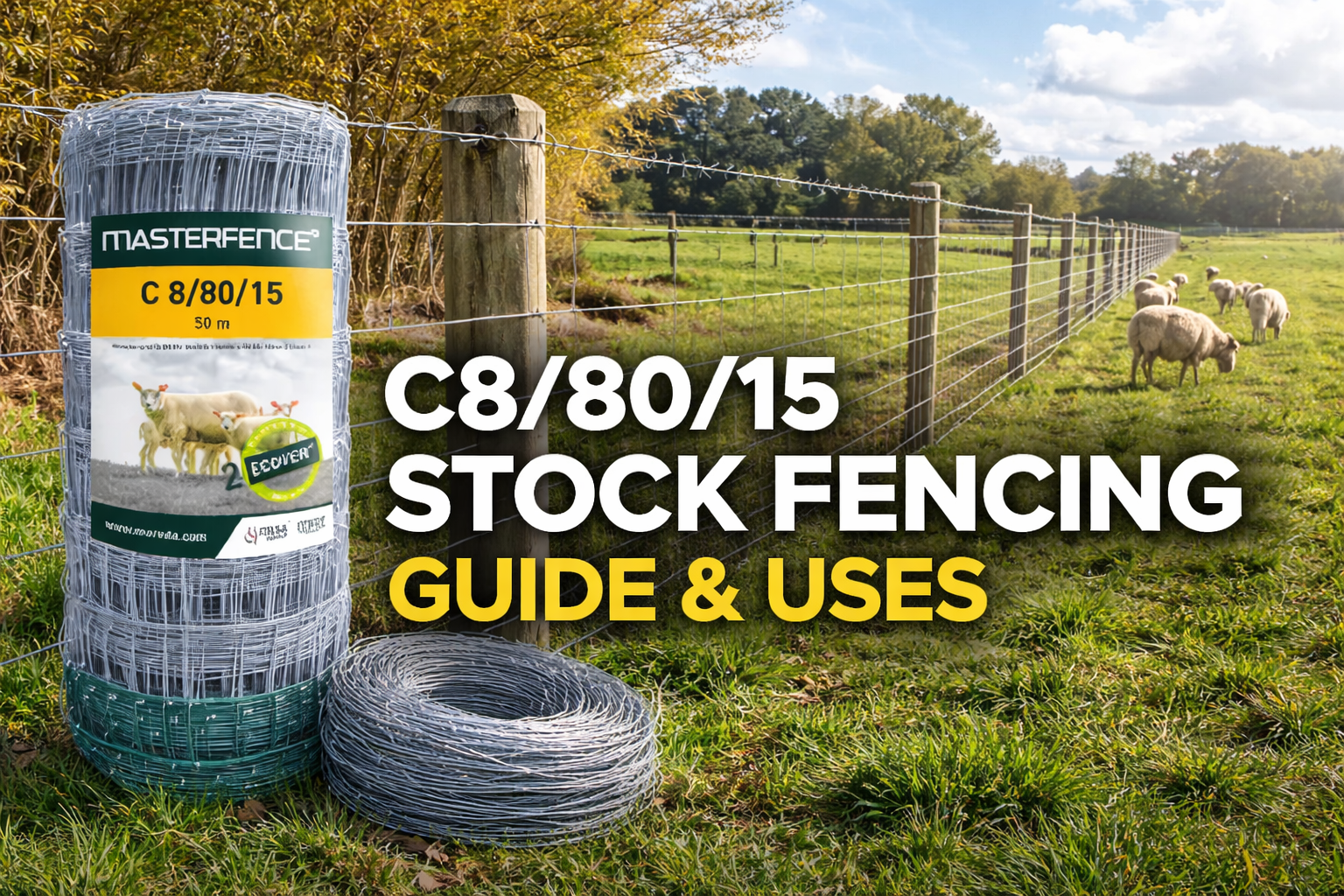
C8/80/15 stock fencing has 8 horizontal line wires, is approximately 80cm high, and has vertical stay wires spaced around 15cm apart. It is commonly used for sheep, livestock, paddocks, smallholdings and agricultural field boundaries. The roll is only one part of the fence: you also need the right strainer posts, intermediate posts, staples or clips, tensioning, and extra planning at corners, gateways, dips and changes of direction.
Stock fencing looks simple when it is still on the roll. The problems usually start when the fence has to hold tension, follow uneven ground, turn a corner, cross a dip, run through a gateway or deal with livestock pressure.
That is why C8/80/15 should not be bought as “just a roll of wire”. It is part of a fencing system. The wire matters, but the strainers, posts, fixings and tensioning decide whether the fence stays upright and useful.
If you are planning sheep fencing, paddock fencing, field boundaries or smallholding repairs, start with the full run: where the fence starts, where it ends, where the pressure points are, and what you need to keep in or out.
What does C8/80/15 stock fencing mean?
The code is a simple way of describing the stock fencing layout:
- C = stock fencing code/type
- 8 line wires
- 80cm height
- 15cm stay spacing
- Graduated mesh
- Galvanised steel wire
- 50m or 100m rolls
In plain English, C8/80/15 is an 80cm high stock fence with 8 horizontal wires and vertical stay wires spaced around 150mm apart. The lower openings are tighter than the upper sections, which helps improve control near the ground.
Wern-Wood’s C8/80/15 Stock Fencing is manufactured from galvanised steel wire and is available in 50m and 100m roll options. The product page lists it as suitable for sheep and livestock fencing, agricultural and field boundaries, paddocks, farmland, and rural perimeter fencing.
Where is C8/80/15 stock fencing used?
C8/80/15 is a practical all-round stock fencing option for many rural jobs. It is especially useful where you need to cover longer runs without building a fully boarded or rail-only fence.
| Use | Why C8/80/15 works | What to plan |
|---|---|---|
| Sheep fencing | 80cm stock netting with tighter lower mesh helps reduce low gaps. | Ground level, dips, gateways and wire tension. |
| General livestock fencing | Creates a practical field barrier for rural stock management. | Livestock type, pressure points and whether extra top wire is needed. |
| Field boundaries | Useful for long continuous fence runs. | Strainers, direction changes, corners and tie-off points. |
| Paddocks | Suitable for dividing land and managing grazing areas. | Gateways, rubbing pressure and whether the fence is suitable for the animals involved. |
| Smallholdings | A flexible option for mixed rural fencing jobs. | Animal type, future repairs and having staples/wire on hand. |
For broader agricultural fencing projects, browse Agricultural Fencing, Agricultural Wire & Barb and Fence Posts together.
C8/80/15 is not the same as the finished fence height
The 80 in C8/80/15 tells you the stock fence mesh height. The finished fence height may be higher if you add barbed wire, plain line wire, electric offset fencing, rails, or other deterrents above the stock netting.
This matters when animals lean, push, reach over, rub, or test the fence line. The stock fence controls the lower part of the boundary, but the top of the fence may need extra planning depending on livestock and pressure.
If the fence is under pressure, do not only ask whether the mesh is strong enough. Ask what is happening at the top, at the ground, and at the strain points. That is where many stock fences start to fail.
When should you add barbed wire?
Barbed wire is often paired with stock fencing where extra deterrent, height or perimeter control is needed. It is commonly installed above the stock fence line, depending on the setup and livestock involved.
Wern-Wood’s Galvanised Barbed Wire is a 200m roll, manufactured from steel wire with a galvanised finish, and is listed for agricultural and livestock fencing, field and boundary fencing, perimeter and security fencing, and use alongside stock and wire fencing systems.
Consider stock fencing plus barbed wire when:
- Cattle or larger animals lean over the fence to graze the other side.
- You need more effective height without changing the mesh.
- The boundary needs extra deterrent or perimeter control.
- The fence runs through high-pressure areas such as gateways, troughs, feeding points or corners.
- The fence is part of a working agricultural boundary, not a decorative domestic fence.
Barbed wire should be handled carefully. Wear suitable gloves and protective equipment, keep wire controlled and taut when dispensing, and take care around recoil, loose ends, livestock, public access and neighbouring land.
The real strength is in the strainers
A stock fence is strained between strong points. The intermediate posts support the line, but they are not what should be holding the main pull of the wire.
That means you need to identify the pressure points before counting ordinary posts.
- End posts finish the run and hold the pull of the wire.
- Corner posts take pressure from more than one direction.
- Gate posts deal with access, livestock pressure and movement.
- Direction changes need stronger planning than a straight run.
- Dips and sudden gradient changes can pull the fence line out of shape.
- Long runs may need additional straining points rather than one continuous pull.
Government fencing specifications and stockproof fencing specifications commonly place strainer posts at ends, changes of direction and changes of gradient. Some stockproof fencing specifications also set strainers at regular intervals on longer runs, such as at least every 100m or 150m depending on the specification and wire type.
What else do you need with C8/80/15?
The roll is only the visible part of the shopping list. A complete stock fencing order may need posts, strainers, staples, barbed wire, gates and ironmongery.
| Item | Why it matters | Wern-Wood starting point |
|---|---|---|
| C8/80/15 stock fencing | Main livestock and boundary mesh. | C8/80/15 Stock Fencing |
| Agricultural posts and strainers | Hold the fence line, tension and pressure points. | Agricultural Fencing |
| Barbed wire | Adds deterrent, height and perimeter control where suitable. | Galvanised Barbed Wire |
| Galvanised staples | Fix wire, mesh and netting to timber posts. | Galvanised Staples |
| Gates and hardware | Access points need hinges, latches and stronger posts. | Agricultural Ironmongery |
Wern-Wood’s galvanised staples are listed for securing fencing wire, mesh and netting to timber posts, with a galvanised finish for improved corrosion resistance in outdoor conditions.
How many rolls of stock fencing do you need?
For a quick estimate, divide the fence length by the roll length, then round up.
- Rolls needed = total fence length ÷ roll length, then round up.
- Available roll options = 50m and 100m.
- Add allowance for tying-off, corners, dips, uneven ground and awkward sections.
Example: a 180m fence run using 50m rolls gives 180 ÷ 50 = 3.6, so you need 4 rolls before considering extra allowance. If the run is awkward, has several turns, or you want contingency for repairs, build in extra rather than ordering exactly to the metre.
How many posts do you need?
Post quantities depend on the fence type, livestock, ground, exposure, wire, terrain and local specification. For a rough planning estimate, many customers start by thinking around 2–3m spacing for intermediate posts, then add the stronger strainers and gate posts separately.
The important part is this: do not count all posts as if they are doing the same job.
| Post type | Job | Planning mistake |
|---|---|---|
| Intermediate posts | Support the fence line between strainers. | Expecting them to hold the main fence tension. |
| Strainer posts | Hold tension at ends, corners, long runs and direction changes. | Using ordinary posts where strainers are needed. |
| Corner posts | Take load from two fence directions. | Forgetting they need stronger treatment and bracing. |
| Gate posts | Carry gates and deal with repeated movement. | Underspecifying the post and ironmongery. |
How should stock fencing be fixed to timber posts?
Use suitable galvanised staples or clips to secure the wire to timber posts. Staples should hold the fencing in position without crushing or locking the wire so tightly that it cannot perform properly.
Good fixing practice depends on the post, wire type and fencing method, but the principle is simple: the wire should be supported consistently and the tension should be carried by the straining system.
For timber post installations, browse Galvanised Staples and the wider Agricultural Wire & Barb range.
Common mistakes with C8/80/15 stock fencing
- Buying the roll but not the strainers — the wire needs proper tension points.
- Forgetting gateways — gate posts and ironmongery do harder work than line posts.
- Ignoring dips and direction changes — these can distort the fence line.
- Ordering exact roll length with no allowance — tying-off and awkward ground use extra wire.
- Using ordinary posts at pressure points — strainers, corners and gateways need more thought.
- Adding barbed wire without safety planning — livestock, public access and handling all matter.
- Not keeping repair stock — spare staples, wire and fixings are useful on rural sites.
- Choosing fencing without considering animal type — sheep, cattle, horses and mixed stock create different pressure.
Before you order stock fencing
Before checkout, work through the whole fence rather than only the roll quantity.
- What animals are being fenced?
- How long is each straight run?
- Where are the ends, corners, gateways and changes of direction?
- Does the ground dip, rise or stay wet?
- Do you need barbed wire, plain line wire or electric offset fencing?
- What posts, strainers and gate posts are needed?
- Do you have suitable galvanised staples or clips?
- Do you need extra materials for future repairs?
- Can delivery access handle rolls, posts and strainers?
For a complete agricultural fencing order, start with C8/80/15 Stock Fencing, then add suitable Agricultural Fencing, Agricultural Wire & Barb, Galvanised Staples and Agricultural Ironmongery.
FAQs
What does C8/80/15 mean on stock fencing?
C8/80/15 means the stock fence has 8 horizontal line wires, is approximately 80cm high, and has vertical stay wires spaced around 15cm apart.
What is C8/80/15 stock fencing used for?
It is commonly used for sheep fencing, general livestock control, agricultural field boundaries, paddocks, smallholdings and rural perimeter fencing.
Is C8/80/15 suitable for sheep?
Yes, C8/80/15 is commonly used for sheep and livestock fencing. The graduated lower mesh helps reduce low gaps, but the finished fence still depends on posts, strainers, tensioning and ground conditions.
Do I need barbed wire with stock fencing?
Not always. Barbed wire is usually added where extra deterrent, height or perimeter control is needed, especially around cattle, high-pressure boundaries, gateways or exposed rural areas. Use it carefully and consider livestock type and public access.
How many rolls of C8/80/15 do I need?
Divide the total fence length by the roll length, then round up. For example, 180m divided by a 50m roll gives 3.6, so you need 4 rolls before allowing extra for corners, tying-off and uneven ground.
What roll lengths are available?
Wern-Wood’s C8/80/15 Stock Fencing is available in 50m and 100m roll options.
What fixings do I need for stock fencing?
For timber posts, use suitable galvanised staples or fencing clips to secure the wire. Choose the fixing to suit the wire, post and installation method.
How far apart should stock fence posts be?
Post spacing depends on the wire, livestock, terrain, ground conditions and specification. As a rough planning estimate, intermediate posts are often considered around 2–3m apart, but strainers, corners and gateways must be planned separately.
Summary: C8/80/15 is the roll — the fence is the system
C8/80/15 stock fencing is a practical choice for sheep, livestock, paddocks, smallholdings and agricultural field boundaries. The code tells you the mesh: 8 horizontal wires, 80cm height and 15cm stay spacing.
But the roll alone does not make the fence. A good stock fence needs proper strainers, intermediate posts, staples, tensioning, and extra planning at gateways, corners, dips and pressure points.
Buy the wire, but plan the whole fence.
Planning a stock fencing job?
Start with the roll, then build the full list: strainers, intermediate posts, barbed wire where suitable, galvanised staples, gates and ironmongery.
Shop C8/80/15 Stock Fencing → Order online or collect from our Briton Ferry yard. Yes, we deliver.Sources checked: Wern-Wood live C8/80/15 Stock Fencing, Galvanised Barbed Wire and Galvanised Staples product pages; Wern-Wood live sitemap; AFAG/FISA fencing safety guidance; GOV.UK and stockproof fencing specifications for strainer placement at ends, direction changes and gradients. This article is general agricultural fencing guidance only. Final fencing specification depends on livestock type, terrain, exposure, ground conditions, pressure points, access, safety requirements and local site conditions.