Skip to content
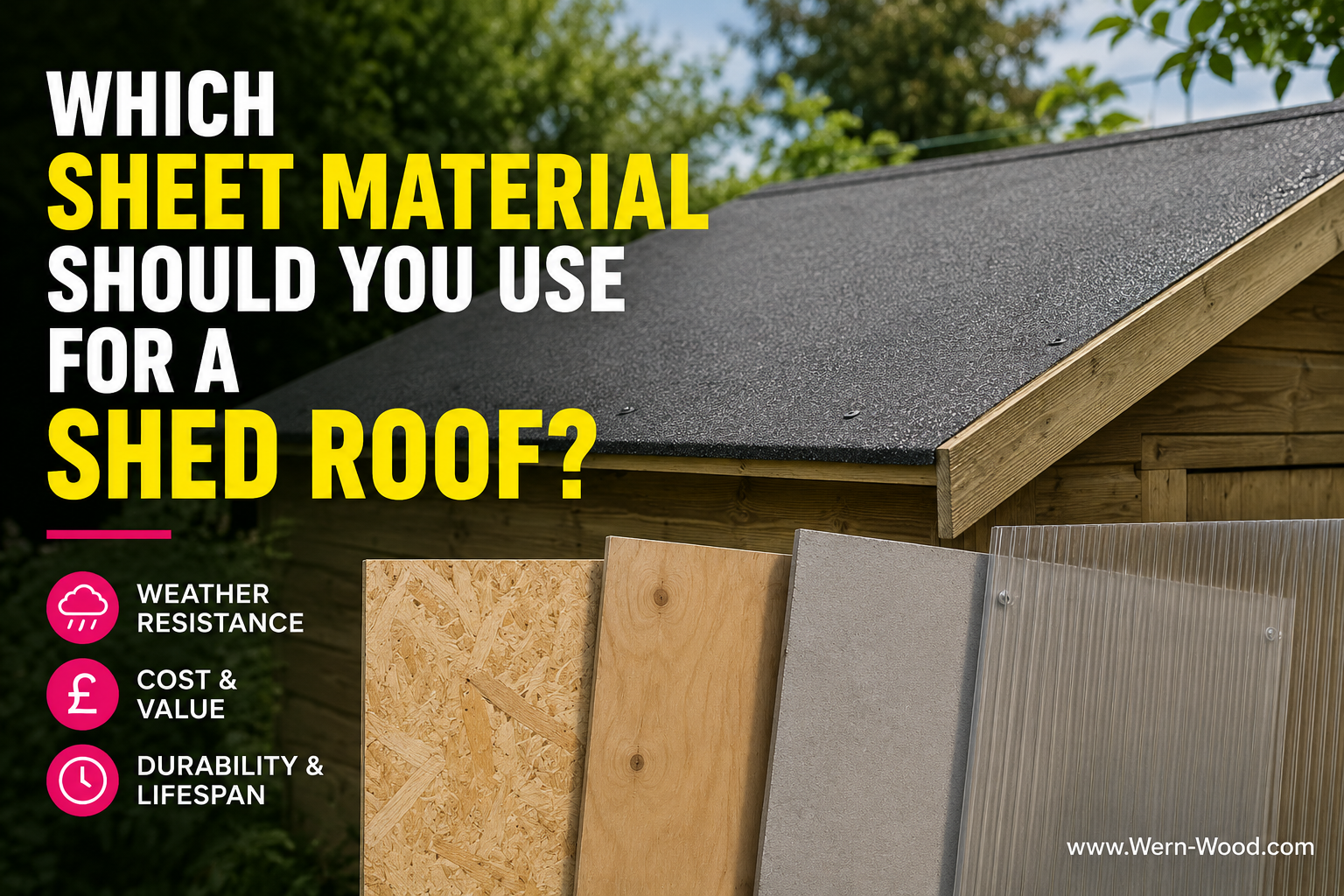
Which Sheet Material Should You Use for a Shed Roof?
Shed Roof Advice

Which Sheet Material Would We Use for a Shed Roof?

6 min read 🪚 OSB, Plywood & Roof Decking 📍 Wern-Wood, Briton Ferry
Quick Answer

For most shed roofs, we would use OSB3. It is practical, strong, usually lighter to handle than many plywood options, and normally more cost-effective. For a traditional garden shed, 11mm OSB3 is often suitable when the roof is properly supported and covered. For a larger shed, higher-budget build, workshop-style building or heavier roof covering, 18mm OSB3 is the stronger upgrade. Plywood is still a valid option if you prefer it, but for most normal shed roofs, OSB3 is the one we would usually choose.

People often ask for “plywood for a shed roof” when what they actually need is a strong sheet material to form the roof deck. That might be plywood, but for most normal shed builds, the better practical answer is usually OSB3.

That does not mean plywood is wrong. Plenty of people still use plywood and prefer plywood. It also does not help to pretend OSB and plywood are the same thing, because they are not. The useful answer is simple: both can work when specified correctly, but OSB3 is usually the sensible choice for a typical shed roof.

OSB3
is a structural grade of oriented strand board designed for load-bearing use in humid conditions. That makes it widely used for roof decking, flooring, wall sheathing, sheds and general building work — but it still needs to be protected from weather as part of the finished roof build-up.

Why OSB3 is usually the best shed roof board

A shed roof board has a simple job: it needs to create a stable roof deck that can support the roof covering and transfer load back into the rafters or roof frame. It does not need to look decorative. It needs to be practical, consistent, easy to fix and suitable for the conditions it will face.

That is where OSB3 makes sense. It is an engineered sheet material made from compressed timber strands bonded into a rigid panel. It is commonly used where strength and coverage matter more than appearance.

  • Good structural sheet for roof decking
  • Usually more cost-effective than plywood
  • Lighter to handle than many plywood options
  • Consistent sheet coverage
  • Easy to cut and fix
  • Suitable beneath felt or EPDM

For a standard garden shed, OSB3 does the job without overcomplicating the build. It gives you a roof deck that can be covered properly, fixed properly and replaced sensibly if the roof ever needs major work later.

11mm or 18mm OSB3 for a shed roof?

This depends on the build. Some people say “shed” and mean a small garden storage shed. Others say “shed” and mean something closer to a summerhouse, workshop, garden office shell or heavy-duty outbuilding.

Those are not the same job.

Board choice Best suited to Why you would choose it
11mm OSB3 Typical garden shed roofs A practical choice for normal sheds when the roof is properly framed, supported, fixed and covered.
18mm OSB3 Larger sheds, workshops, summerhouse-style builds or stronger roof decks A stronger, more solid board where the build is higher budget, the roof is larger, or the covering/build-up is heavier.
Plywood Projects where plywood is preferred or specifically required Still a valid option, but often not necessary for a straightforward shed roof when OSB3 is suitable.

When 11mm OSB3 is usually enough

For a traditional garden shed roof, 11mm OSB3 is usually the practical option. It keeps the roof deck manageable, avoids unnecessary weight, and gives a sensible base for felt or EPDM when the roof frame is properly built.

The important phrase there is “properly built”. The board thickness is only one part of the roof. Rafter spacing, edge support, fixings, roof pitch and the final covering all affect how well the roof performs.

When 18mm OSB3 makes more sense

Use 18mm OSB3 when the building is more than a basic garden shed. If you are building something closer to a workshop, summerhouse, garden office shell or higher-budget outbuilding, the extra stiffness can be worth it.

It is also the better direction where the roof is larger, the roof covering is heavier, or you simply want a stronger and more solid roof deck. You are not just buying thickness for the sake of it — you are adding strength and stiffness where the job justifies it.

Yard advice

If the project is “just a shed”, check what that actually means. A small storage shed and a workshop-style garden building are different jobs. The sheet material should match the build, not just the word “shed”.

Where plywood still fits

Plywood is not wrong. Some people prefer it, some builders are used to it, and some projects may specify it. If you want to use a suitable plywood sheet, that is a valid route.

The important thing is not to create confusion. OSB is not plywood, and plywood is not OSB. They are different sheet materials. But for this particular job — creating a covered shed roof deck — both can be suitable when the correct grade, thickness and installation are used.

For most normal shed roofs, though, we would still usually point you toward OSB3 because it gives a strong, practical roof deck without overbuying.

The big warning: OSB3 is not waterproof

This is the mistake that causes problems. OSB3 is moisture resistant. It is not waterproof.

Moisture resistant means the board is designed to cope better with humid conditions than dry-use boards. It does not mean it should be left exposed as the finished roof surface. A shed roof still needs a suitable roof covering over the board.

Important OSB3 warning

Do not leave OSB3 exposed to the weather as the finished shed roof. It must be covered with a suitable roof covering such as felt or EPDM. If OSB3 is left exposed to rain, standing water or long-term wet conditions, the board can swell, soften at the edges and deteriorate.

Felt or EPDM: what should go over the board?

For a shed roof, the common roof coverings to recommend are felt or EPDM rubber roofing. Both can work well when fitted correctly over a properly supported roof deck.

Felt is the traditional shed roof covering and is widely used for straightforward garden buildings. EPDM is often chosen where you want a more robust rubber roofing system, especially on better-quality sheds, workshops or outbuildings.

The sheet material underneath still matters. A good covering over a badly supported roof deck is still a weak roof. The roof board, frame, fixings and covering need to work together.

Support spacing and sheet edges matter

The most common shed roof mistake is treating the sheet as if it can do all the work on its own. It cannot. OSB3 needs proper support underneath it.

Where possible, sheet edges should land on the centre of rafters, joists or noggins. That way, both sheets have something solid to fix into and the joint is supported properly. Unsupported board edges can flex, lift, sag or create weak points under the roof covering.

  • Support board edges properly
  • Land joints on rafters or noggins
  • Use suitable fixings
  • Avoid unsupported sheet joins
  • Keep boards protected before covering
  • Cover with felt or EPDM

If the roof layout means a board edge does not land neatly on a rafter, add a noggin or supporting timber rather than leaving the joint floating. That small framing detail makes the roof deck much better.

Simple rule

The board should not be expected to bridge awkward gaps on its own. Plan the roof frame so the board joints are supported, especially at sheet edges and ends.

So what would we use?

For most shed roofs, we would use OSB3.

Use 11mm OSB3 for a normal garden shed where the roof is properly framed, supported and covered. Step up to 18mm OSB3 for larger sheds, stronger builds, workshop-style buildings, heavier roof coverings or where you want a more solid roof deck.

Plywood is still a valid option if you prefer it, but for the usual shed roof question, OSB3 is the practical winner.

FAQs

Is OSB3 better than plywood for a shed roof?

For most shed roofs, OSB3 is usually the more practical choice because it is strong, consistent, easy to handle and often more cost-effective than plywood. Plywood is still a valid option if preferred, but it is not always necessary for a normal shed roof.

Can OSB3 be used outside?

OSB3 can be used in humid conditions and as part of external roof build-ups, but it should be protected. It should not be left exposed to weather as the finished surface. For a shed roof, cover it with felt or EPDM.

Is 11mm OSB3 enough for a shed roof?

For many traditional garden sheds, 11mm OSB3 is a sensible option when the roof frame gives proper support and the board is covered correctly. Larger or stronger builds may justify 18mm OSB3.

When should I use 18mm OSB3?

Use 18mm OSB3 where the roof is larger, the building is closer to a workshop or summerhouse, the roof covering is heavier, or you want a stronger and more solid roof deck.

Can I put felt straight onto OSB3?

Yes, felt is commonly fitted over OSB3 roof decking when the board is properly fixed, dry, clean and supported. Always follow the instructions for the specific felt or adhesive system being used.

Can I put EPDM over OSB3?

Yes, EPDM is commonly used over suitable roof decking, including OSB3, where the system instructions allow it. The board should be dry, clean, properly fixed and supported before the EPDM is installed.

OSB3 Shed roof Sheet materials Roof decking Plywood EPDM Shed felt

Building or repairing a shed roof?

Browse our OSB3 sheets for shed roofs, roof decking, flooring, wall sheathing and general building work. Choose the right thickness for your build and make sure the board is properly supported and covered.

Shop OSB3 Sheets → Order online or collect from our Briton Ferry yard. Yes, we deliver.

General guidance only. Sheet thickness, support spacing, fixing pattern, roof covering, roof pitch, exposure and intended use can all affect what is suitable. OSB3 is moisture resistant, not waterproof, and must be protected from long-term wet exposure. Sources checked include Wern-Wood OSB3 product information, EN 300 OSB classification guidance, SmartPly OSB3 technical data and Kronospan OSB technical guidance.