
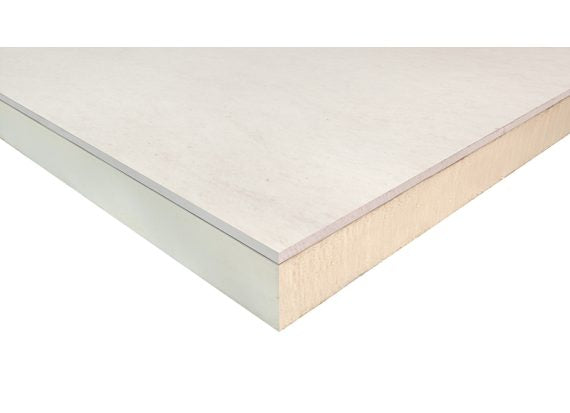
Insulated plasterboard for thermal dry lining
Insulated plasterboard combines plasterboard and rigid insulation in one board for internal thermal upgrades. Our PIR insulated plasterboard, also commonly searched for as thermal plasterboard, is designed for dry lining walls, roof linings, reveals and refurbishment projects where insulation and a plasterboard lining are needed together.
Insulated plasterboard thicknesses
Our insulated plasterboard is supplied as 2400 × 1200mm tapered-edge boards in four overall thicknesses: 37.5mm, 52.5mm, 62.5mm and 72.5mm. These are approximate total board thicknesses, combining a 12.5mm plasterboard facing with different PIR insulation thicknesses.
Choosing the right insulated plasterboard
Thicker insulated plasterboard generally provides more insulation than thinner boards in the same product range, but the right choice depends on the existing construction, available space and thermal target. Where a project has a specific U-value requirement, use the relevant product performance data and project specification rather than choosing by thickness alone.
Where is insulated plasterboard used?
- Internal solid-wall upgrades and refurbishment work
- Loft room and roof lining applications
- Dormer cheeks and sloping ceilings
- Internal partitions where additional thermal performance is required
- Window and door reveals where a suitable build-up can be maintained
Insulated plasterboard FAQs
What size are the boards?
They are 2400 × 1200mm with tapered edges.
What thicknesses are available?
37.5mm, 52.5mm, 62.5mm and 72.5mm overall thicknesses.
Is insulated plasterboard the same as PIR insulation board?
No. Insulated plasterboard is a laminated board combining plasterboard and PIR insulation. A standalone PIR insulation board does not include a plasterboard facing.
Does a thicker board always mean a better result?
Within the same system, greater insulation thickness usually improves thermal resistance, but the full wall or roof build-up determines final performance.
Can I use ordinary plasterboard instead?
Standard plasterboard is suitable where thermal insulation is not required as part of the board. For normal dry internal lining, see our Plasterboard Sheets.