

Description
Quick answer: PIR insulated plasterboard is used for internal dry lining where you want to improve thermal performance while creating a ready-to-finish plasterboard surface. It is suitable for internal walls, roof linings, pitched roof applications, reveals and refurbishment work, but final insulation performance depends on the board thickness, full build-up, fixing method and installation quality.
What is this used for?
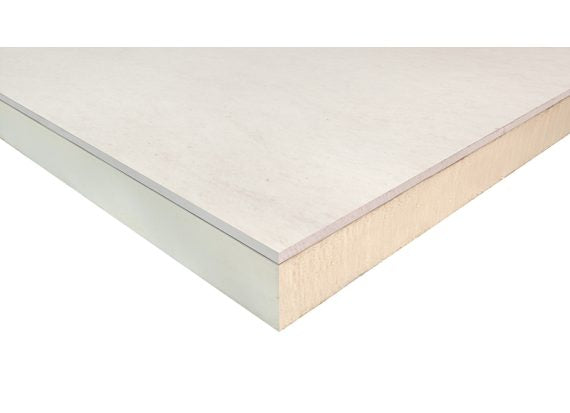
PIR insulated plasterboard combines a plasterboard face with rigid PIR insulation in one board. It is designed for internal dry lining projects where you want to add insulation and create a plasterboard surface ready for finishing.
Typical uses include internal walls, cold walls, roof linings, pitched roof applications, loft conversions, window and door reveals, energy-efficiency upgrades and refurbishment projects.
Is this the right plasterboard for your project?
Choose PIR insulated plasterboard where you need to improve thermal performance without building a separate insulation layer and plasterboard layer. It can be a practical option where space matters, because the insulation and plasterboard are combined into one board.
This board helps improve thermal performance, but it should not be treated as a guaranteed insulation result by itself. The final performance depends on the thickness chosen, the wall or roof build-up, the background, fixing method, joints, gaps, thermal bridging and workmanship.
The product page states that this board can help support Part L building regulation compliance. However, compliance depends on the full specification, installation and building requirements, not just the board on its own.
Which thickness should you choose?
These boards are available in 37.5mm, 52.5mm, 62.5mm and 72.5mm thicknesses. Thicker boards generally provide better insulation, but they also take up more room inside the space.
Before ordering, check how much insulation depth you need, how much room you can afford to lose, and whether your project has a specific thermal requirement. If a U-value or building regulation target must be met, the full build-up should be checked before choosing the board thickness.
What does PIR backed mean?
PIR backed plasterboard has rigid PIR insulation bonded to the back of the plasterboard. PIR is commonly used where good thermal performance is needed without using excessive thickness.
This product has a 12.5mm tapered edge gypsum plasterboard front face, a PIR rigid insulation core and a kraft paper rear face with aluminium foil backing.
What does tapered edge mean?
The plasterboard face has tapered long edges. This creates space for jointing tape and jointing compound, making the board suitable for tape-and-joint finishing.
It can also be skimmed if required, but tapered edge boards are especially useful where the joints are being taped and filled rather than the whole surface being fully skim plastered.
Key features
- PIR insulation backing: Helps improve the thermal performance of internal walls, roof linings and dry lining projects.
- Plasterboard and insulation in one board: Reduces the need for separate insulation and plasterboard layers in suitable applications.
- Multiple thicknesses available: Choose from 37.5mm, 52.5mm, 62.5mm and 72.5mm depending on the project requirement and available space.
- Tapered edge plasterboard face: Suitable for tape-and-joint finishing and can also be skimmed if required.
- Foil-backed rear face: Designed to support thermal efficiency as part of the board construction.
- Suitable fixing methods: The product page states that the boards can be installed using dot and dab adhesive systems or mechanical fixings.
Things to check before ordering
- Thickness: Thicker insulated plasterboard usually improves insulation performance, but reduces internal room space.
- Thermal target: If you need to meet a specific U-value or Part L requirement, check the full wall or roof specification before ordering.
- Installation method: Confirm whether the board will be fixed using dot and dab adhesive, mechanical fixings or another specified system.
- Internal use: This product is for internal dry lining applications, not external use or areas exposed to direct water.
- Moisture exposure: Do not use insulated plasterboard where it will be in direct or continuous contact with water.
- Structural use: This is not a standalone structural board.
- Fixings and finishing: Make sure you have suitable drywall screws, fixings, jointing materials and finishing products for the installation method.
- Storage: Store boards flat, dry and protected before installation.
Complete the job
For fixing PIR insulated plasterboard, you may need suitable drywall screws or mechanical fixings depending on the background and installation method. You may also need plasterboard adhesive, scrim tape, jointing compound, angle beads and finishing plaster depending on how the boards are being fitted and finished.
If this is not the right board for the job, view the full plasterboards and dry lining range, including standard plasterboard, moisture resistant plasterboard and fire rated plasterboard. For standalone insulation boards, view PIR insulation.