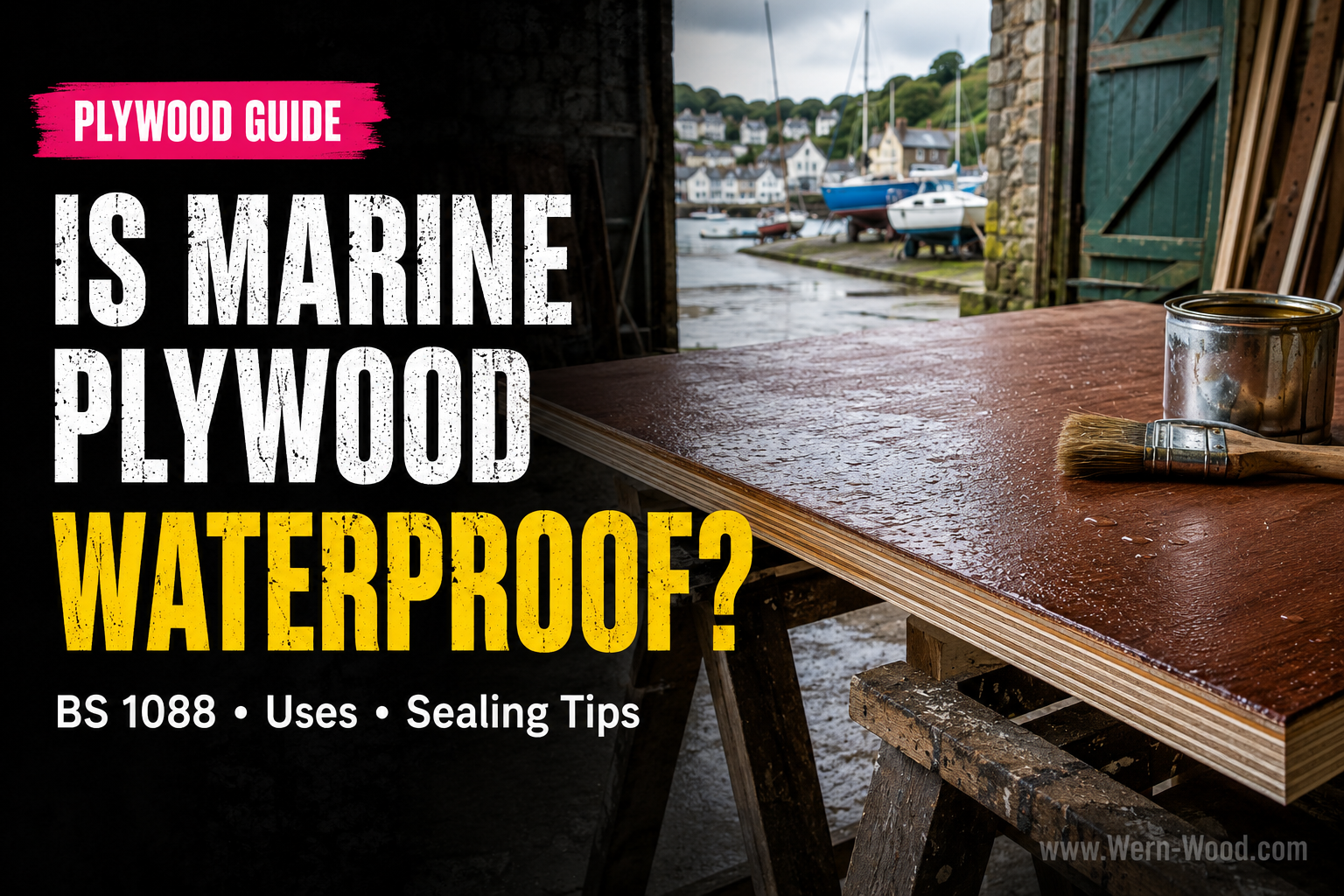
Is Marine Plywood Waterproof?
What BS 1088:2018 actually covers, where marine plywood makes sense, which thickness to choose, and how to protect the finished sheet.
Marine plywood is commonly chosen when a project will face damp conditions, splashes, humidity or weather exposure. That could include boat work, exterior joinery, utility-room cabinets, garden structures or panels used in other moisture-prone environments.
The important distinction is that marine plywood is made to a defined specification. It is not an alternative to waterproof detailing. Water can still enter through exposed faces, cut edges, drilled holes, damaged coatings and poorly designed joints.
Need marine plywood manufactured to BS 1088 requirements?
Wern-Wood stocks full 2440 × 1220mm sheets in 6mm, 9mm, 12mm and 18mm thicknesses.
What is marine plywood?
Marine plywood is made from layers of timber veneer bonded together, with the grain direction normally alternating between adjacent layers. This cross-laminated construction helps create a stable sheet.
Marine plywood manufactured to meet BS 1088:2018 must satisfy defined requirements covering matters such as veneer species and quality, panel construction and bond performance. The standard is particularly concerned with resistance to biological deterioration and loss of bond strength over time.
That makes it appropriate where the project specification calls for marine plywood or where a high-quality plywood is required for demanding marine or moisture-prone conditions. It does not guarantee every property needed for every finished project.
What does BS 1088:2018 mean?
BS 1088:2018 is the current British Standard for marine plywood. It specifies requirements for two classes: standard marine plywood and lightweight marine plywood. Its primary intended applications are marine craft and other marine or waterway uses, although building-construction use is also considered.
The standard particularly addresses resistance to biological deterioration and the retention of bond strength over time. It does not cover every property that may be relevant to a particular use.
Where plywood is used as a construction product, the project specification may also require declared performance or conformity under other relevant standards, such as BS EN 13986. Structural, fire, coating and regulatory requirements must be checked separately where applicable.
For buyers, the practical meaning is that BS 1088 provides a defined marine-plywood specification. It is a strong starting point when marine plywood is required, but the finished design and protection system still matter.
Is marine plywood completely waterproof?
No. The panel is designed to retain its bond and resist deterioration under demanding conditions, but the timber veneers can still absorb moisture. Repeated wetting can lead to swelling, surface checking, staining and deterioration if the sheet is badly detailed or left unprotected.
Think of marine plywood as a suitable base material for a demanding project—not as the final waterproofing layer.
If you are comparing marine plywood with structural, birch, phenolic or general-purpose sheets for outdoor work, read our broader guide to which plywood can be used outside and what “waterproof plywood” actually means.
Cut edges need particular attention
A freshly cut edge exposes every veneer layer. Water entering the edges can cause uneven swelling and may create damage that looks like delamination. Cut-outs, drilled holes, damaged corners and fixing points deserve the same attention.
For long-term exposed use, protect both faces and every edge with a coating system suitable for the project. Keep sheets dry during storage and installation rather than relying on the marine-plywood specification to tolerate poor site protection.
When should you use marine plywood?
Boat and marine work
Repairs, internal panels, lockers and components where the design or specification calls for marine plywood. Boat-building work still needs the correct design, bonding and coating system.
Exterior joinery
Painted external panels, signs, boxed sections and joinery where a marine-plywood specification is appropriate and the board can be fully protected and detailed to shed water.
Damp internal rooms
Bathrooms, utility rooms and other humid spaces where a high-quality plywood is useful. It does not replace tanking or another specified waterproof system in directly wetted areas.
Garden and outdoor projects
Outdoor cabinets, covered worktops and similar finished projects where the board will be sealed, kept clear of standing water and maintained.
Which marine plywood thickness should you choose?
Thickness affects stiffness, weight, fixing depth and the support spacing required behind the board. The correct choice depends on the span, loading, framing and project specification—not simply whether the job is indoors or outdoors.
Marine plywood compared with other plywood
Marine plywood is not automatically the best sheet for every job. It earns its place when the marine-plywood specification, veneer quality and long-term bond durability matter. For dry, temporary or normal construction work, another board may be more suitable and economical.
| Sheet material | Typical use | Moisture approach | Choose it when… |
|---|---|---|---|
| BS 1088 Marine Plywood | Marine work, selected exterior joinery and demanding finished projects | Manufactured to defined marine-plywood requirements; still needs end-use protection | The specification calls for marine plywood or its defined construction and durability are justified |
| Structural Hardwood Plywood | General construction and supported sheet work where the product’s declared specification is suitable | Use and protect it according to its declared performance and project specification | You need a construction sheet rather than a marine-plywood specification |
| General Purpose Hardwood Plywood | Dry internal joinery, boxing, shelving and utility work | Keep dry unless the individual product documentation states otherwise | The project is internal and marine plywood would add unnecessary cost |
| Shuttering Plywood | Concrete formwork and temporary construction tasks | Selected for construction utility rather than a fine, permanently exposed finish | Appearance and long-term exposed performance are not the priority |
Marine plywood may be more than the job needs
For normal building work, compare it with structural hardwood plywood. For dry internal utility work, general-purpose hardwood plywood may be sufficient.
How to protect marine plywood
The correct protection depends on the project. Exterior paint systems, compatible wood sealers, marine coatings and epoxy systems may all be appropriate in the right application. Follow the coating manufacturer’s instructions for preparation, compatibility, coverage and maintenance.
- Start with a dry sheet. Store it flat, supported and protected from rain before cutting or coating.
- Complete cuts and drilling where practical. Every cut creates a newly exposed edge.
- Ease sharp external edges lightly. A very sharp corner is difficult to coat evenly.
- Protect cut edges and holes carefully. These are common routes for water entry.
- Coat all required faces. Protecting only the visible face can leave the reverse vulnerable.
- Finish fixing points. Do not leave damaged coating or exposed penetrations untreated.
- Inspect the finished project. Repair cracked coatings, open joints or exposed edges before water enters.
Good detailing matters as much as the coating
Provide drainage, avoid water-trapping joints, cover vulnerable top edges and allow suitable ventilation behind panels. Keep plywood away from permanent ground contact and standing water unless the complete assembly has been designed for that exposure.
How to cut and fix marine plywood
Support the sheet before cutting
Full 2440 × 1220mm sheets are awkward to control. Support the whole board, mark the cut clearly and use a suitable blade. Position the visible face appropriately for the tool to reduce breakout.
Pre-drill near edges
Pre-drilling can reduce splitting and gives better control close to corners. Keep fixings an appropriate distance from the edge and avoid over-driving through the face veneer.
Use fixings suitable for the environment
For exterior or marine environments, choose corrosion-resistant fixings suitable for the exposure, surrounding materials and project specification.
Support sheet joints
Do not leave joints floating between framing members. Support sheet edges, allow any required movement gap and protect exposed joints as part of the finishing system.
Common marine plywood mistakes
- Assuming marine means waterproof: the finished project still needs waterproof detailing and protection.
- Calling BS 1088 a certification: it is a British Standard defining product requirements.
- Leaving cut edges bare: edges can take up water rapidly and swell unevenly.
- Using it in standing water: better plywood does not correct poor drainage or design.
- Buying 18mm for every job: thicker is heavier and more expensive; support and loading determine the right choice.
- Using marine plywood where ordinary plywood is enough: dry internal or temporary work may not justify it.
- Treating BS 1088 as a structural approval: loads, spans and support spacing must be determined separately.
- Coating only the visible face: moisture can enter through the back, edges, holes and joints.
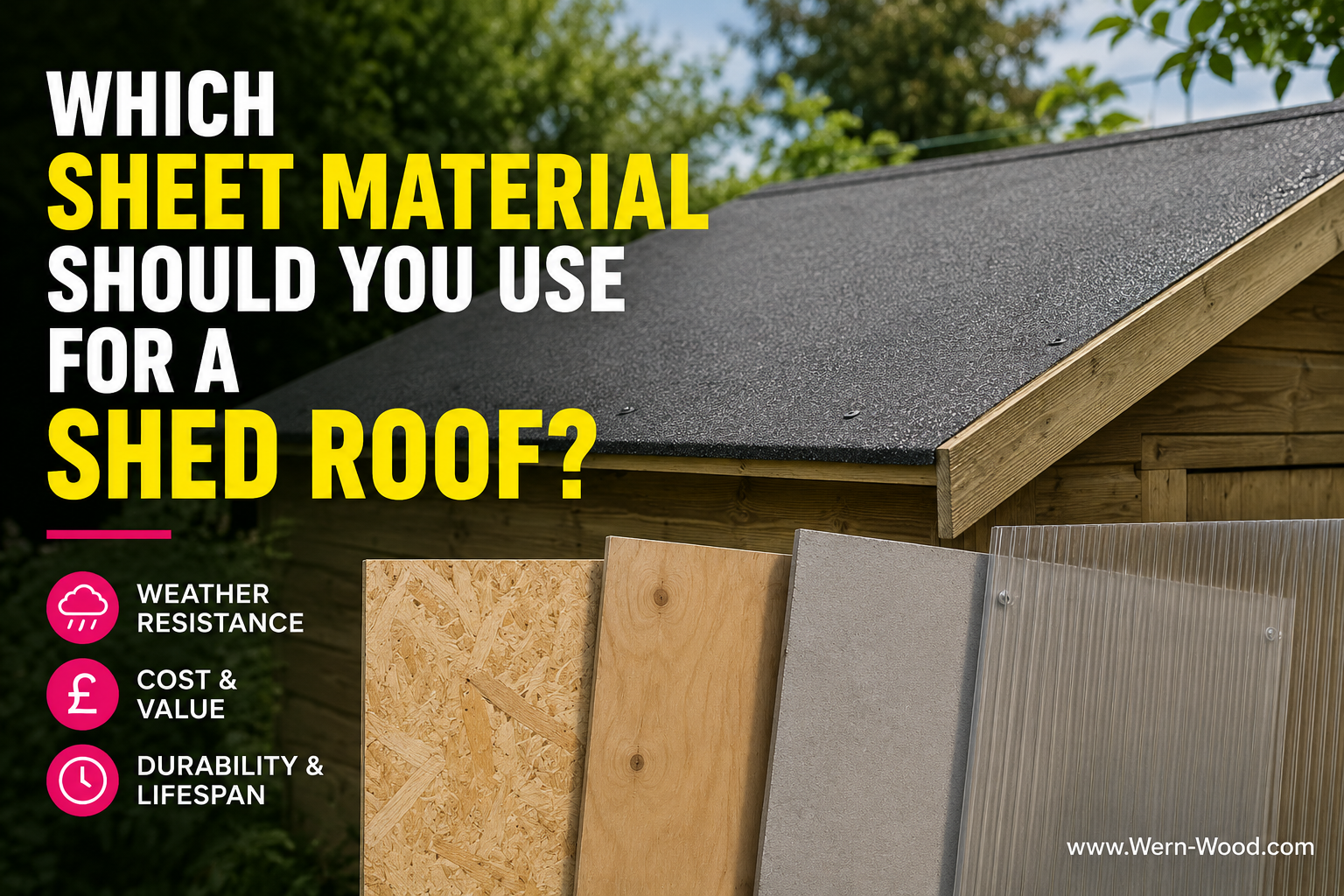
Is marine plywood suitable for a shed roof?
It may be used as a roof deck where the product documentation, thickness, framing and roof-covering specification are suitable, but it is often more expensive than necessary. For many ordinary garden sheds, OSB3 is the more practical choice because the roof covering—not the bare sheet—provides the weatherproof layer.
Read our full comparison: Which Sheet Material Should You Use for a Shed Roof?
Marine plywood FAQs
Can marine plywood be left outside?
Do not assume an unfinished sheet can be left permanently exposed. Protect the faces, edges, holes and fixing points with a suitable system, detail the project to shed water and maintain the finish.
Does BS 1088 mean the board is waterproof?
No. BS 1088 sets requirements for marine plywood and particularly addresses biological durability and retention of bond strength over time. It does not make the sheet or finished installation a maintenance-free waterproof system.
Is BS 1088 a certification?
No. It is a product standard. A manufacturer may state that plywood is manufactured to meet its requirements, but any independent certification or third-party approval should be confirmed from the product documentation.
Can marine plywood be used in a bathroom?
It can be useful in humid or splash-prone rooms when properly protected. It does not replace specified tanking in showers, wet rooms or other directly wetted areas.
Should marine plywood be painted or sealed?
For exposed applications, use a compatible protection system suitable for the environment. Follow the coating manufacturer’s preparation and maintenance instructions.
Is 12mm or 18mm marine plywood better?
Neither is universally better. 18mm is stiffer and provides more fixing depth, while 12mm is lighter. The correct choice depends on loading, span, support spacing and the project specification.
Choose your marine plywood thickness
Order full 2440 × 1220mm sheets manufactured to meet BS 1088 requirements in 6mm, 9mm, 12mm or 18mm.