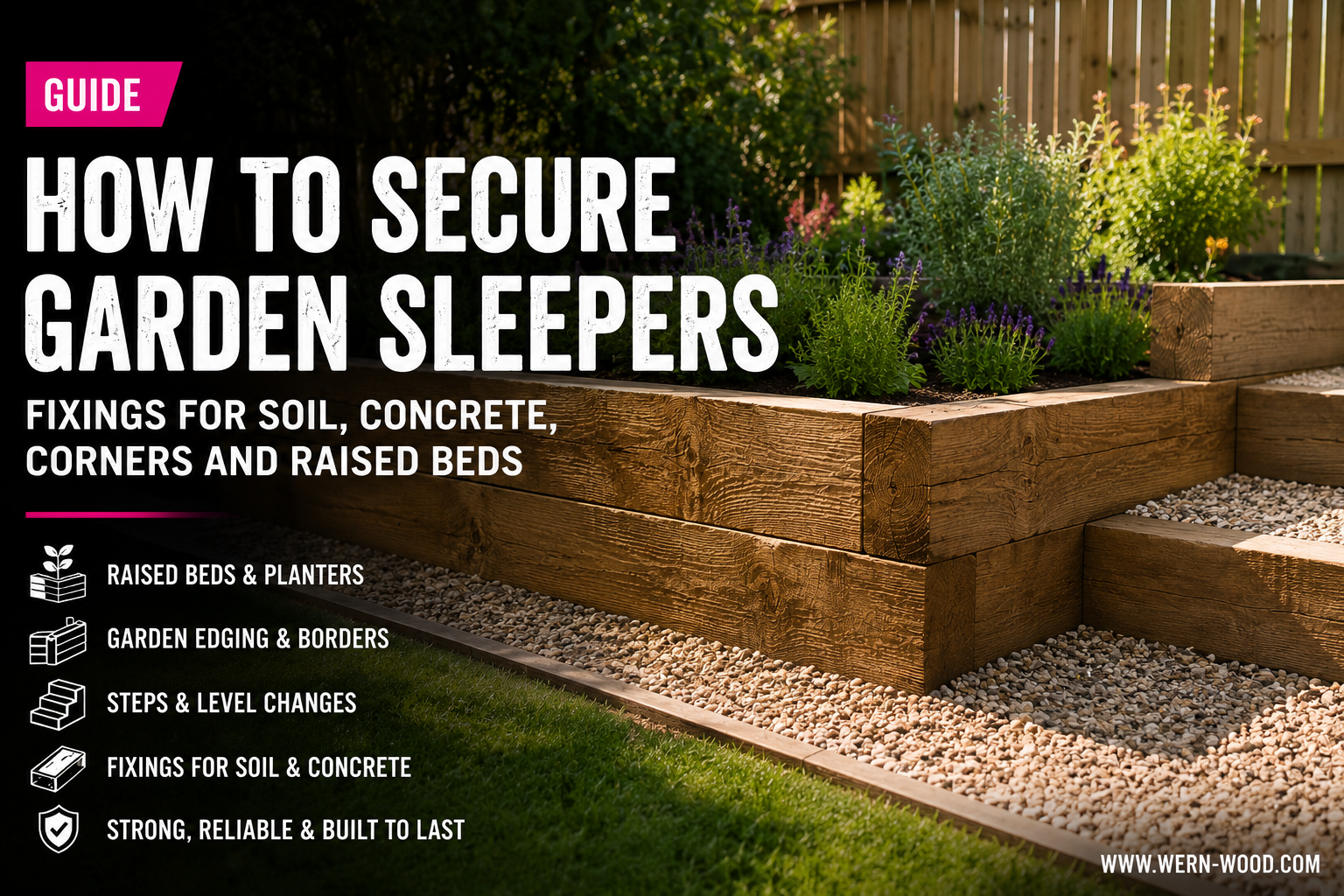
The best way to secure garden sleepers depends on what they are sitting on and how they are joined. Sleepers installed in soil can be restrained with purpose-made support spikes. Sleepers on a concrete base need an anchor designed for hard standing. Corners and straight joints can be strengthened with brackets or flat plates, while direct timber-to-timber connections normally require suitable structural timber screws.
This guide helps you choose the fixing by the job you are doing, then links to the exact product once you know what you need.
Which fixing should you use for garden sleepers?
There is no single fixing that suits every sleeper project. Start with the surface beneath the sleeper, then consider whether you are forming a straight run, a corner, a raised bed or a stacked structure.
| What you are doing | Suitable route | Product to consider |
|---|---|---|
| Holding a straight sleeper run in soil | A ground-driven support positioned to restrain the sleeper. | Sleeper Support Spikes |
| Securing a sleeper corner in soil | A corner support combined with a properly formed timber joint. | Sleeper Support Spikes |
| Installing sleepers on concrete or hard standing | A base anchor fixed to the concrete with suitable masonry fixings. | Sleeper Base Anchors to Concrete |
| Reinforcing corners or straight joints | An internal corner bracket or straight support plate. | Sleeper Brackets & Flat Support Plates |
| Joining sleepers directly together | Long exterior-rated screws intended for substantial timber connections. | Performance Hex Drive Structural Timber Screws |
How to secure garden sleepers in soil
For garden edging, borders and raised beds built over soil, the first job is to prepare a firm and level base. Remove loose topsoil and vegetation, compact the ground and use a suitable granular base where the project needs better drainage or a more stable line.
Once the sleepers are level, purpose-made supports can help stop them moving sideways or drifting out of line. Sleeper Support Spikes are available for straight runs and corners, with options for single- and double-sleeper arrangements.
Use the correct spike for the layout
- Single Sleeper - 440mm / Straight supports a single sleeper along a straight run.
- Single Sleeper - 440mm / Corner is shaped for corners rather than being forced into a straight application.
- Double Sleeper - 750mm / Straight provides a longer support for a two-sleeper-high straight section.
- Brown and galvanised finishes are available across the range, depending on the selected option.
The spike should be driven into suitable ground and positioned so that it supports the timber without pulling the sleeper out of level. Very soft, recently disturbed or waterlogged ground may need additional preparation because the fixing is only as stable as the ground holding it.
Choose the support by sleeper height, straight run or corner, then select brown or galvanised where available.
View Sleeper Support Spikes →How to fix garden sleepers to concrete
Sleepers placed on a patio, concrete path, slab or other hard standing cannot be secured with a ground spike. They need a fixing that connects the timber to the concrete base.
Sleeper Base Anchors to Concrete provide a dedicated fixing point for this type of installation. The base of the anchor is fixed to the concrete, then the sleeper is secured to the upright section of the anchor.
The concrete fixing itself must suit the base you are drilling into. Use an appropriate masonry screw, anchor or plug system and follow its drilling diameter, hole depth and embedment instructions. Avoid assuming that every slab or block has enough thickness and strength for the same fixing.
Mark the full sleeper layout first. Check that the line is square, the anchor positions will not clash with joints, and the drill holes remain a safe distance from the edge of the concrete.
Available in brown or galvanised finishes for securing timber sleepers to suitable concrete bases and hard standing.
View Sleeper Base Anchors to Concrete →How to join garden sleepers at corners
A sleeper corner can be formed with a butt joint, an overlapping joint or a more detailed cut joint. For most straightforward raised beds and garden borders, a square butt or overlapping corner is the practical route.
The timber still needs to be held together. An Internal Corner Bracket from the Sleeper Brackets & Flat Support Plates range can reinforce the inside of the corner while keeping the outside face clean. Brown and galvanised versions are available.
Structural timber screws can also be driven through one sleeper into the end or side of the adjoining sleeper. The fixing length and direction should provide useful embedment without breaking through the visible face.
- Keep the Internal Corner Bracket on the inside of the bed.
- Check the corner is square before tightening all fixings.
- Use more than one fixing point so the joint cannot twist around a single screw.
Choose an Internal Corner Bracket for corners or a Straight Flat Support Plate for straight joints and reinforcement.
View Sleeper Brackets & Flat Support Plates →How to join sleepers in a straight run
Long borders and raised beds often need two or more sleeper lengths joined end to end. Set the ends on a firm, level base and keep both pieces aligned before fixing them together.
A Straight Flat Support Plate can bridge the joint and help keep the faces in line. It can be positioned where it is less visible, such as the inside face of a raised bed or the rear of an edging run.
If the sleepers are stacked, avoid lining every vertical joint up in the same place. Staggering the joints between courses helps the overall assembly act as one structure rather than a series of separate columns.
How to secure sleepers for raised beds
A simple sleeper raised bed normally combines more than one fixing method. The exact combination depends on the bed height, whether it sits on soil or concrete, and whether the sleepers are joined directly or reinforced with hardware.
For the timber itself, Pressure Treated Garden Sleepers 195 x 95mm are available in several lengths, making it easier to plan the bed around practical cuts and reduce unnecessary joints.
Choose the sleeper lengths around your finished raised-bed dimensions, then add the fixings that suit the base and joint layout.
Shop Garden Sleepers →How to secure stacked garden sleepers
Stacked sleepers need restraint between courses as well as support against sideways movement. Start with a level first course; every error at the base becomes more noticeable as the wall gets higher.
For a simple two-sleeper-high straight run in suitable soil, the Double Sleeper - 750mm / Straight option in the Sleeper Support Spikes range provides a support designed around that arrangement. Straight plates and long structural timber screws can then help connect joints and courses.
Stagger end joints where possible and avoid relying on one fixing at each joint. Large screws installed near the end of dry timber may benefit from a pilot hole to reduce splitting and make positioning easier.
Decorative edging and a low raised bed are not the same as a retaining wall. Where sleepers hold back a significant depth of soil, carry a load, form a substantial step or sit beside a drop, the foundation, drainage and restraint should be properly designed for the job.
What screw length should you use for sleepers?
Sleepers are substantial timbers, so short general-purpose woodscrews are rarely useful for direct sleeper-to-sleeper joints. The correct length depends on the joint direction, sleeper thickness and how much sound timber the screw can enter.
Performance Hex Drive Structural Timber Screws are available in useful landscaping lengths including 100mm, 150mm and 200mm. Shorter lengths can suit brackets and smaller connections, while longer screws may be needed when fixing directly through one substantial timber into another.
Do not choose by length alone. Diameter, head size, corrosion protection, edge distance and fixing pattern all affect the connection. Our separate timber screw size guide explains the starting principles in more detail.
Available in individual screws and box quantities across several lengths for sleeper, landscaping and substantial timber projects.
View Structural Timber Screws →How to secure sleepers for steps and level changes
Sleeper steps need a stable base, consistent tread dimensions and positive restraint so that individual timbers cannot rock or creep forward. The best fixing method depends on whether the steps are formed over compacted ground, built against an existing structure or anchored to concrete.
Sleeper Support Spikes can help restrain suitable low garden arrangements in soil. Sleeper Base Anchors to Concrete are the relevant route where the structure starts from hard standing. Brackets, flat plates and structural timber screws can connect individual components, but they do not compensate for an unstable base.
Where steps carry regular foot traffic, sit beside a drop or also retain soil, treat the layout as a structural landscaping job rather than simple decorative edging.
Common mistakes when securing garden sleepers
- Installing on loose topsoil without creating a level and stable base.
- Using a straight support at a corner rather than choosing the product shaped for the layout.
- Using a single-sleeper support for a stacked run that needs a longer double-height option.
- Using ordinary internal screws outdoors where corrosion protection and treated-timber compatibility matter.
- Lining up every joint when stacking multiple sleeper courses.
- Fixing into weak or thin concrete without checking the base and masonry fixing requirements.
- Ignoring drainage where retained soil and trapped water can increase pressure behind the sleepers.
- Treating a retaining wall like a low border and relying on hardware alone.
Frequently asked questions
Do garden sleepers need to be secured?
Not every low decorative sleeper needs the same level of restraint, but securing the timber helps keep straight runs aligned, corners square and stacked courses stable. The need increases with height, retained soil, slopes and regular loading.
Can garden sleepers sit directly on soil?
They can be used over soil, but loose topsoil is rarely a good finished base. Remove vegetation and soft material, level and compact the area, and consider a suitable granular base where drainage or long-term alignment matters.
How do you stop sleepers moving in soil?
Prepare a firm base and use the correct Sleeper Support Spike for the layout. Straight, corner, single-sleeper and double-sleeper arrangements require different support shapes and lengths.
How do you fix a sleeper to concrete?
Use a Sleeper Base Anchor to Concrete, secure the anchor with masonry fixings suited to the concrete, then fasten the timber to the anchor. Follow the masonry-fixing manufacturer's drilling and embedment instructions.
What should I use to join sleeper corners?
An Internal Corner Bracket can reinforce the inside of a raised bed or border. Suitable structural timber screws can also form a direct connection through one sleeper into another.
Can I use ordinary wood screws for sleepers?
Small general-purpose screws are normally too short or light for direct sleeper joints. Use an exterior-rated fixing intended for substantial timber, and select the length and diameter around the full connection.
Choose the sleeper and fixing for your project
Start with the surface and layout, then open the matching product to choose the exact option.
This guide provides general practical information for garden landscaping. Retaining walls, substantial steps, load-bearing structures and safety-critical work may require a designed foundation, drainage system and fixing arrangement. Follow product instructions and obtain competent advice where the consequences of movement or failure are significant.