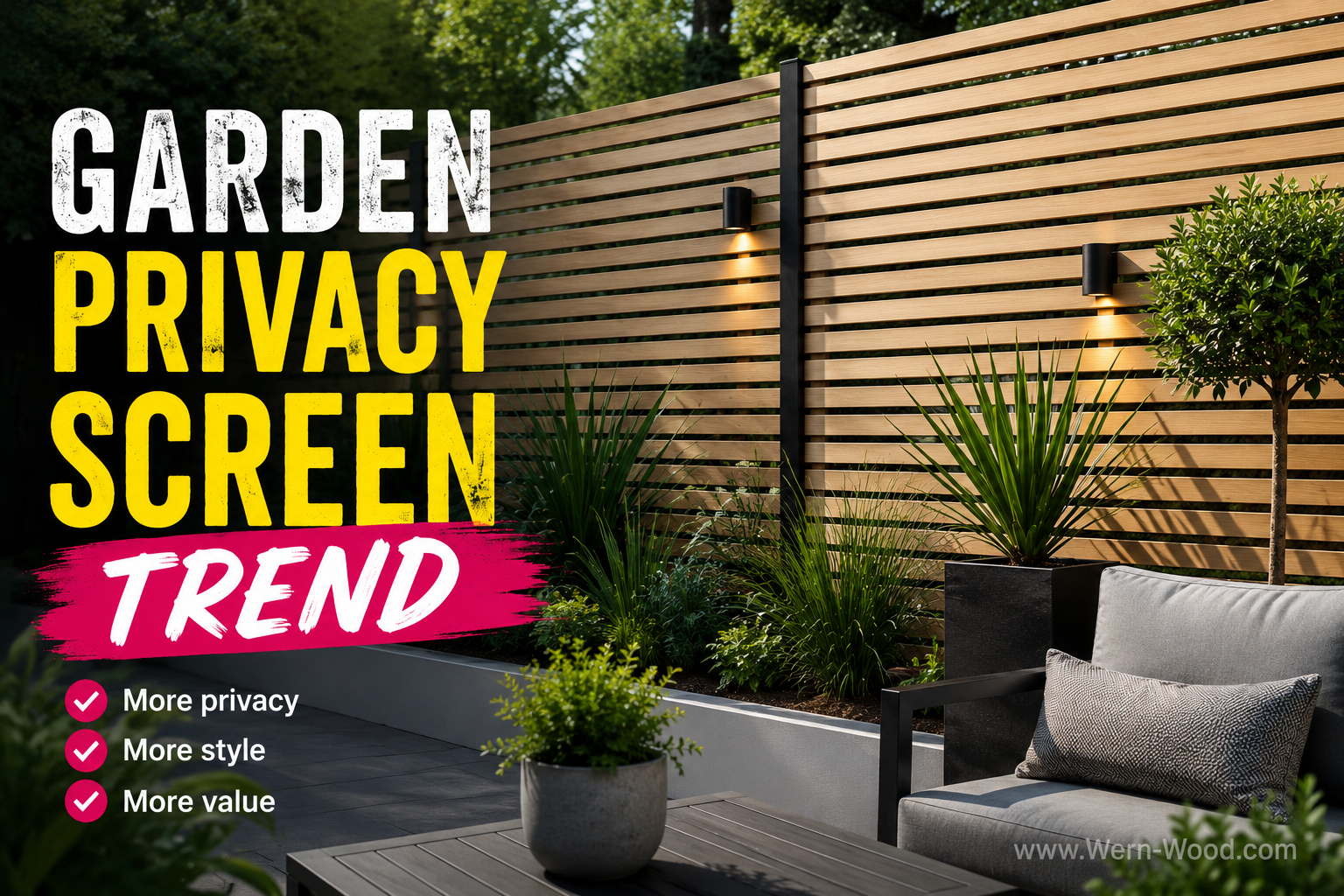
If you want a timber garden privacy screen, first decide how much you want to see through it. A one-sided slatted or Venetian screen gives a lighter, more open finish. A double-sided hit-and-miss fence removes the direct sightline through the gaps. If you want the slatted look with a darker, more closed background, add black weed control membrane behind the battens.
All three can be built with our rounded-edge fence and landscaping battens. The difference is the layout, gap and amount of timber used.
Use a one-sided slatted screen for the cleanest, simplest build
For horizontal slatted fencing, we normally use main posts around 1.8m centres with intermediate support so the battens have a fixing point around every 900mm. Use the same maximum support spacing if you install the battens vertically.
Use around 10–20mm gaps where privacy is the priority. Increase the gap towards 15–30mm for a more open garden screen. Cut one spacer block and use it throughout the build rather than measuring every gap.
See How to Build a Slatted Fence or Venetian Garden Screen for the installation method.
Use hit-and-miss when you do not want a direct sightline
Hit-and-miss uses battens on both sides of the supports. The rear row is offset so it covers the gaps in the front row. Around 25mm overlap is a useful starting point in our normal layout, but the important rule is that the rear batten must cover the gap enough to remove the direct sightline.
It uses more timber than a one-sided screen, but both faces are finished in timber. That also makes it the kinder choice where one face is directly towards a neighbour rather than leaving them looking at the back of membrane or framing.
See How to Build a Hit-and-Miss Fence.
Use black membrane for contrast, privacy or to hide the background
We regularly recommend black weed control membrane behind a one-sided slatted screen. The black backing gives much stronger contrast between the timber battens and makes the gaps look darker.
It is useful for privacy, but that is not its only job. It works particularly well when the screen is being installed in front of old brickwork, a wall, fencing or anything else you want to hide.
Do slatted fences cope better with wind?
The gaps allow some wind to pass through the fence, which is an advantage over a completely solid face. However, do not use the gaps as a substitute for a strong fence structure. In exposed areas, use larger posts, set them deeper and use suitable strong fixings.
Choose the layout before calculating the timber
- Modern slatted look with light through: one-sided screen.
- More privacy from a one-sided screen: use a tighter 10–20mm gap.
- No direct sightline through the timber: double-sided hit-and-miss.
- Both neighbours see a finished timber face: double-sided hit-and-miss.
- Slatted look with a dark background: one-sided screen with black membrane.
Once you know the layout, use the Landscape Batten Calculator to work out the materials, then go directly to the fence and landscaping battens.