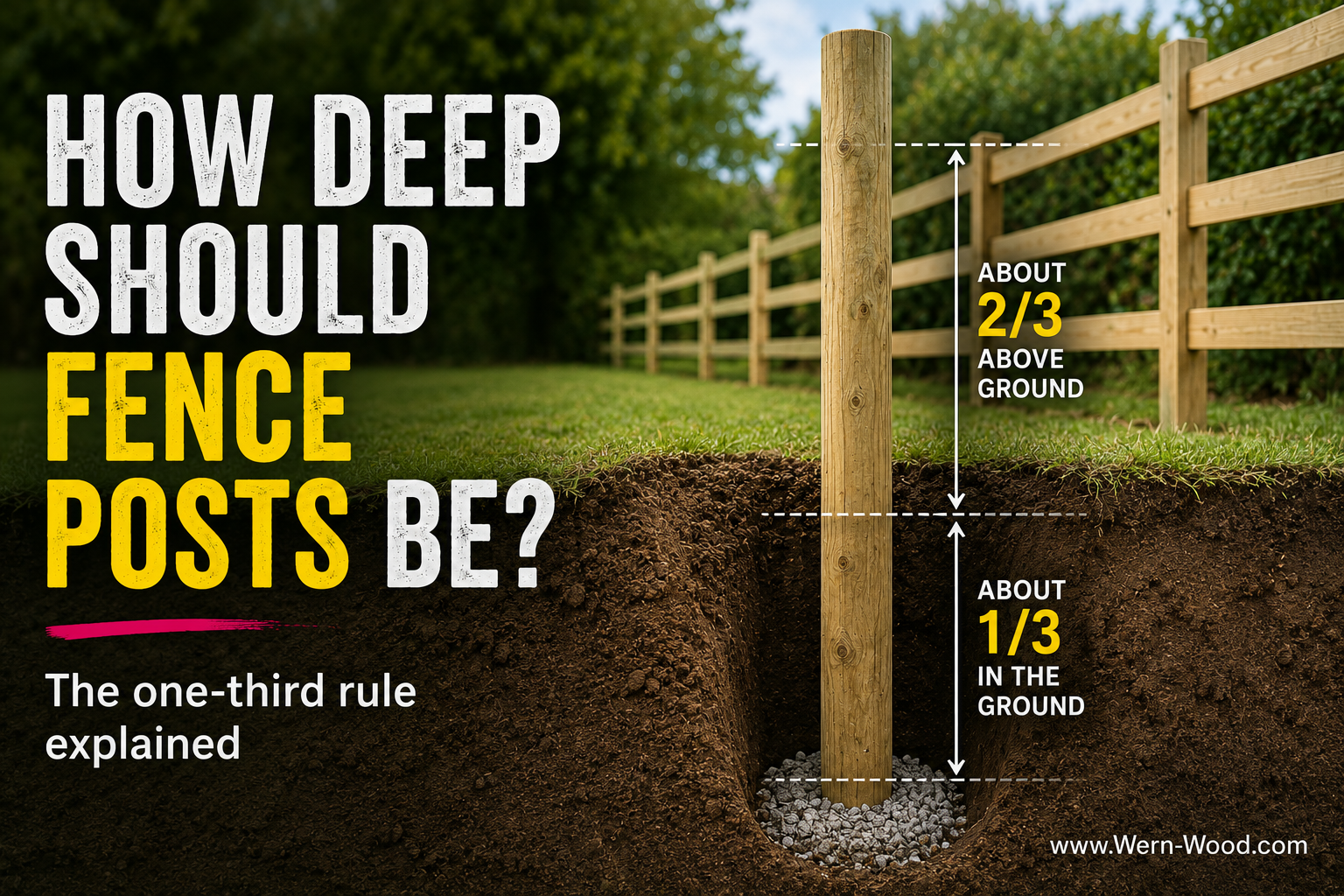
For most standard garden fencing, start with a fence post depth of around 600mm. A typical 6ft fence therefore usually starts with an 8ft post, leaving roughly 6ft above ground and 2ft below.
Taller, heavier or more exposed fences can need deeper posts. Soft or wet ground also changes the job, and gate posts should be assessed separately because they carry different loads from an ordinary intermediate post.
The simple fence post depth guide
| Fence or post job | Typical starting depth | What to watch for |
|---|---|---|
| 4ft–5ft garden fence | Around 600mm | Normal sheltered domestic fencing when the post is properly fixed. |
| 6ft garden fence | 600–750mm | Move towards the deeper end where the fence is more exposed or the ground is softer. |
| Over 6ft or very exposed fencing | 750–900mm may be appropriate | Height, wind exposure, post size and local planning requirements become more important. |
| Gate post | Job-specific | Gate size, weight, post size, hinges and ground conditions all matter. |
| Agricultural or strained fencing | Job-specific | Strainers, corners and changes of direction take different loads from intermediate posts. |
These are practical starting points rather than structural calculations. The correct depth still depends on the fence, ground, exposure and the job each post is doing.
What length fence post do I need?
Work backwards from the finished fence height and the depth you intend to bury the post. The common mistake is buying a post that is the same length as the finished fence.
| Finished fence height | Typical buried depth | Post length to consider |
|---|---|---|
| 4ft fence | Around 600mm | 6ft post |
| 5ft fence | Around 600mm | 7ft post |
| 6ft fence | Around 600mm | 8ft post |
| 6ft exposed fence | 750mm or more may be appropriate | A longer or heavier-duty post may be needed |
A useful rule of thumb is to allow roughly one-third of the intended above-ground fence height below ground. For a 6ft fence, that points towards about 2ft, or roughly 600mm, below ground as a starting point.
Not every post in a fence run does the same job
Different posts take different forces, so one depth is not automatically right for every position in a run.
- Intermediate posts carry the normal run of panels, rails or boards.
- End posts can take extra stress because the run stops there.
- Corner posts take load from more than one direction.
- Gate posts carry the moving weight and leverage of the gate through the hinges.
- Agricultural strainer posts can carry substantial tension from stock or wire fencing.
For a standard domestic panel fence, intermediate posts are normally straightforward. Corners, ends, gates and strained fencing deserve separate consideration.
What changes how deep a fence post should be?
Fence height
The taller the fence, the more leverage wind can create. A low picket fence does not put the same demand on a post as a 6ft closeboard or featheredge fence.
Ground conditions
Soft, wet, made-up or recently disturbed ground gives less support than firm ground. If the sides of the hole crumble or the ground feels unstable, stopping at the easiest depth is rarely the best approach.
Wind exposure
Open gardens, hillier areas, fields, corner plots and coastal locations can put more force through a fence. In exposed positions, depth, post size and fixing method need to be considered together.
The load on the post
A heavy gate, a strained agricultural fence or a substantial corner post does a different job from a normal intermediate garden-fence post. Treat the installation accordingly.
Get the depth right before working out the Postmix
Postmix or traditional concrete can secure a post in the hole, but neither can compensate for a post that has been set too shallow. Decide the depth and post size first, then work out the fixing material.
If you are using rapid-set Postmix, use our separate guide to how much Postmix you need per fence post. That page owns the bag-quantity question; this guide stays focused on depth.
If you are deciding which fixing material to use, see Postmix vs Concrete for Fence Posts.
Check before you dig
Fence post holes are still excavations. Before digging, consider underground services, particularly near houses, drives, paths, outbuildings and boundaries.
- Check plans or known service routes where available.
- Look for inspection covers, outside taps, ducting, lighting, sheds and previous groundworks.
- Take extra care near buildings, drives, walls and existing services.
- Use appropriate safe-digging practice where buried services may be present.
Common fence post depth mistakes
- Using a 6ft post for a 6ft finished fence — the buried section has been forgotten.
- Stopping the hole too shallow — the fence has less resistance once wind loads it.
- Ignoring soft or wet ground — poor ground can require more depth or a different approach.
- Treating gate posts like ordinary posts — a gate adds moving weight and hinge load.
- Assuming extra Postmix fixes a shallow hole — fixing material does not replace adequate depth.
- Ignoring exposure — an open or windy site can need a more substantial installation than a sheltered garden.
Before you order fence posts
Work out the complete post requirement before ordering:
- Finished fence height — the visible height you want.
- Buried depth — how much post will be below ground.
- Overall post length — visible height plus the buried section.
- Post role — intermediate, end, corner, gate or agricultural post.
- Ground and exposure — firm, soft, wet, exposed or sheltered.
Timber posts going directly into the ground should also be suitable for ground-contact use. Browse our Fence Posts once you know the length and type required.
Fence post depth FAQs
Is 600mm deep enough for fence posts?
For many standard domestic fence posts, 600mm is a sensible starting depth. Taller fencing, soft ground, exposed locations, heavy fencing and gate posts can require more.
How deep should posts be for a 6ft fence?
For a 6ft garden fence, around 600–750mm is a practical starting range. Move towards the deeper end where the fence is exposed, the ground is softer or the installation is more demanding.
What length post do I need for a 6ft fence?
An 8ft post is the usual starting point for a standard 6ft finished fence because it allows roughly 6ft above ground and 2ft below. More demanding sites can require a longer or heavier post.
Should one-third of the post be underground?
It is a useful rule of thumb, not a universal rule. For a 6ft fence it points you towards about 2ft, or roughly 600mm, below ground as a starting point.
How deep should a gate post be?
There is no single depth for every gate post. Gate size and weight, post size, hinges, ground conditions and exposure all matter. Treat a gate post separately from a standard intermediate fence post.
Summary
For ordinary garden fencing, start at around 600mm deep. Increase the depth where the fence is taller, heavier or more exposed, where the ground offers less support, or where the post is doing a more demanding job such as carrying a gate.
Choose the post length only after allowing for the buried section. That avoids one of the most common fence-planning mistakes: buying a post that is the same length as the finished fence height.
Shop Fence Posts once you know the depth, length and post type required.