Quick answer: Tee hinges are a straightforward, surface-mounted choice for many timber gates, shed doors and ledged doors. Hook and band hinges use a long band on the gate and a separate hook on the post or frame, making them a traditional choice for more substantial timber gates. The correct choice depends on the gate construction, width, weight, post, fixings and how the gate will be used—not hinge length alone.
Choosing gate hinges is not simply a case of buying the longest pair available. The hinges must suit the gate, and the gate itself must have solid ledges or framing in the right positions to accept them. This guide explains the difference between tee hinges and hook and band hinges, then shows how our light, medium and heavy tee-hinge ranges fit into the decision.
Tee hinges and hook and band hinges compared
| Hinge type | How it works | Why you might choose it |
|---|---|---|
| Tee hinge | One leaf fixes across the face of the gate or door while the shorter leaf fixes to the post or frame. | Simple fitting, a wide range of sizes and duty levels, and a familiar choice for garden gates, side gates, shed doors and ledged doors. |
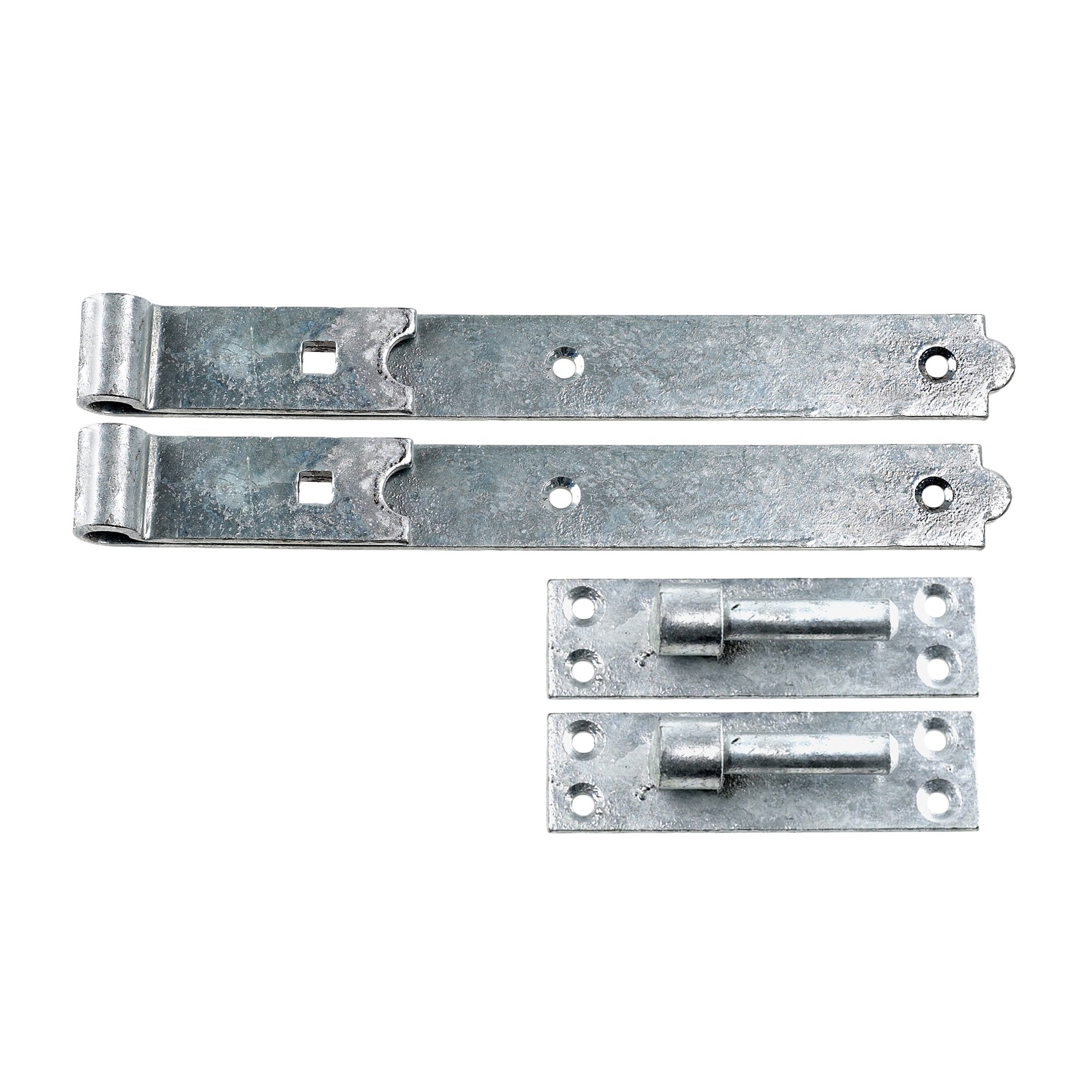
| Hook and band hinge | A long band fixes to the gate and pivots on a separate hook fixed to the post or frame. | A traditional gate-hanging arrangement with a substantial band running across the gate. Useful where this fitting style suits the gate framing and post. |
When should you use tee hinges?
Tee hinges are commonly used where the gate or door has a flat face and suitable ledges behind it. The long arm should be positioned over solid timber so the fixings pass into the gate structure rather than relying only on thin face boards.
They are a practical choice for:
- Timber garden and side gates
- Shed and outbuilding doors
- Ledged and braced doors
- Repairs where an existing tee-hinge layout is being replaced
The important decision is not only the hinge length. You also need to select the correct duty range. We now stock separate, clearly identified Eliza Tinsley ranges:
Light tee hinges
Light Tee Hinges are available in the smaller sizes in our range. They are intended for lighter doors, small gates and similar applications where the gate construction and fixing points are suitable.
Medium tee hinges
Medium Tee Hinges cover the middle of the range and provide a step up from light hinges for more substantial garden gates, shed doors and ledged doors.
Heavy tee hinges
Heavy Tee Hinges are the heavier-duty tee-hinge option in the range. They are available for larger gate and door applications where the gate, post and fixings are all suitable.
Do not choose by length alone. A long light hinge and a shorter heavy hinge are not automatically interchangeable. The hinge construction, gate design, fixing pattern and timber condition all matter.
When should you use hook and band hinges?
Hook and band hinges are made from two main parts: the band attached to the gate and the hook attached to the gate post or frame. The long band spreads the fixing points across a wider section of the gate and gives the installation a traditional gate-hardware appearance.
They are often chosen for:
- Traditional timber garden gates
- Wider or more substantial framed gates
- New gates designed around hook and band hardware
- Installations where separate bands and hooks are preferred
Our main Eliza Tinsley option is the Straight Band & Hooks On Plate Pair, supplied as a matched pair with several size and finish options. We also stock a separate Straight Hook & Band Hinge range.
Which hinge length should you choose?
Hinge length should suit the gate width and, more importantly, align with solid horizontal ledges or framing. A hinge fixed mainly into featheredge boards, tongue-and-groove boards or another thin facing material will not be properly supported.
Before ordering, check:
- The overall gate width and height
- The gate construction and approximate weight
- The position and depth of the ledges or frame
- The condition and size of the gate post
- The fixing type and fixing length required
- The clearance needed for the gate to swing
- Whether the selected hinge finish suits the rest of the hardware
There is no universal rule that one hinge length fits every gate of a particular width. When the gate is unusually wide, heavy, exposed or valuable, the complete installation should be checked rather than relying on a general size guide.
Common gate-hinge mistakes
Fixing into the face boards only
The hinge should connect to the structural part of the gate. Position the hinge over a solid ledge or rail and use compatible fixings of the correct type and length.
Ignoring the gate post
Strong hinges cannot compensate for a loose, undersized or decayed post. Check the post and its foundations before rehanging a sagging gate.
Assuming longer always means stronger
Length is only one part of the specification. The hinge range, material thickness, pin, fixing holes and gate construction also affect suitability.
Mixing unrelated hinge parts
When using hook and band hinges, choose compatible bands and hooks. A complete matched pair removes uncertainty over whether the two parts are intended to work together.
Can you buy a complete gate hardware set?
Yes. A complete gate set can simplify the order where its included hinge size, latch and bolt suit your gate. See our Gate Set A and Gate Set D, or compare the full range in our wooden garden gate hardware guide.
What should you choose?
Choose tee hinges when you want a straightforward surface-mounted hinge and can match the correct light, medium or heavy range to a properly framed gate or door. Choose hook and band hinges when you want a traditional two-part gate hinge with a long band fixed across the gate.
Once the hinges are selected, the next decision is how the gate will open and stay closed. Read our guide to Suffolk, ring and automatic gate latches, or browse all gate hinges.