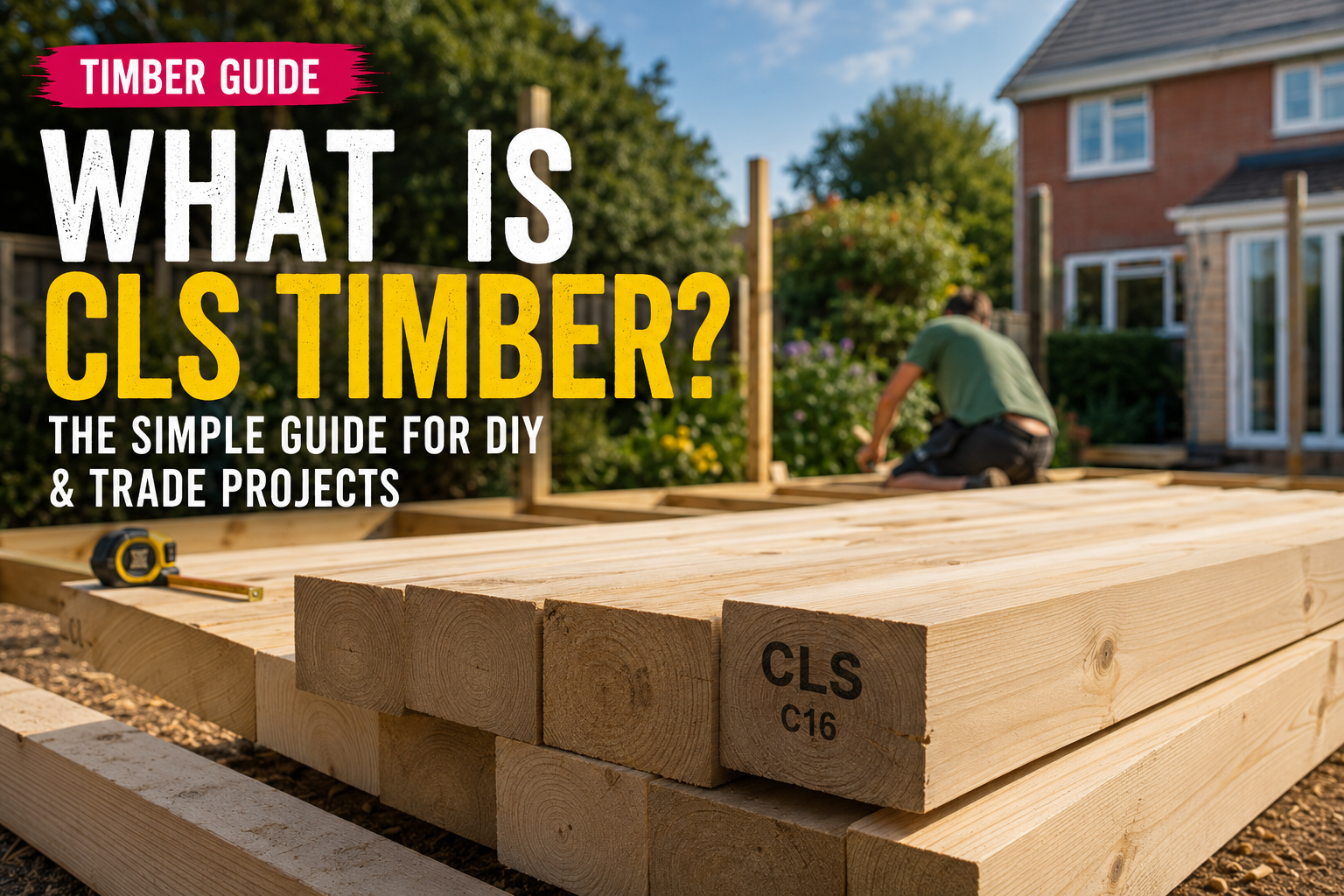
CLS Timber Is Perfect for Stud Walls — But Not for Every Timber Job
CLS timber, short for Canadian Lumber Standard, is planed softwood with smooth faces and eased edges, commonly used for internal stud walls, partitions, boxing-in, service voids and general interior framing. It is quick to handle, consistent in size and ideal for clean internal work. Standard CLS is usually for dry internal use, so do not assume it is suitable for outdoor, damp or ground-contact projects unless the specific product is treated and specified for that use.
CLS timber is one of the easiest building timbers to recognise once you have used it. Smooth faces, rounded corners, easy handling and consistent sizing make it a go-to choice for stud walls and internal frames.
The confusion starts when CLS gets treated as a timber for everything. It is not. CLS describes the format and finish of the timber. It does not automatically mean the timber is suitable outside, suitable for every structural job, or the same thing as C16, C24 or treated carcassing timber.
Use CLS where it shines: internal studwork, framing and clean interior construction. Use something else when the job needs external treatment, heavy structural design, ground contact or a different timber specification.
What is CLS timber?
CLS timber is planed softwood used mainly for internal framing. It is usually planed on all four sides and has rounded, eased edges, which makes it easier and safer to handle than rough sawn timber.
That smooth finish is why CLS is so popular for studwork. It helps keep framing neat, reduces splinters during handling and gives a more consistent base for plasterboard, OSB, plywood, MDF or other sheet materials.
Wern-Wood’s CLS studwork timber is planed strength graded softwood, available in popular framing sizes including 38×63mm and 38×89mm, in 2.4m and 4.8m lengths. It is described as ideal for internal framing, stud wall construction, partitions, garage framing, renovations and general construction work. Browse CLS Timber.
- Planed softwood
- Eased edges
- Internal studwork
- Partition walls
- Boxing-in
- Service voids
- Garage framing
- DIY frames
What is CLS timber used for?
CLS is best known for stud walls, but it is useful for a wide range of internal framing jobs.
| Job | Why CLS works well | What to check |
|---|---|---|
| Stud walls | Smooth, consistent framing for plasterboard and internal partitions. | Stud size, centres, wall height, board type and whether the wall is loadbearing. |
| Boxing in pipework | Easy to cut, handle and fix for neat service boxing. | Access panels, moisture risk and fixing points. |
| Garage conversions | Useful for internal frames, lining walls and forming partitions. | Damp risk, insulation, ventilation and Building Control requirements. |
| Loft and room dividers | Works well for lightweight internal partitions and framing. | Structural requirements, fire/sound requirements and board specification. |
| DIY storage and simple frames | Smooth finish and easy handling make it beginner-friendly. | Load, fixing method and whether the timber will stay dry. |
For complete internal framing jobs, CLS is often used alongside Sheet Materials, Plasterboards & Plaster, Insulation and suitable Screws & Fixings.
If you are building a stud wall, CLS is usually the clean starting point. But if the timber is going outside, near damp, in ground contact, or doing a structural job beyond normal internal framing, pause before buying. CLS might not be the right product.
Is CLS timber structural?
CLS can be strength graded and suitable for some structural internal applications, but the word CLS itself does not replace the actual specification.
CLS describes the finished timber format: planed, smooth and eased-edge. A strength class such as C16 or C24 describes structural performance. Those are different things.
Wern-Wood’s CLS product is described as planed strength graded softwood suitable for studwork applications, but the correct size, centres, load and wall design still matter. If the wall is loadbearing or part of a regulated structural design, follow the drawings or get competent advice.
CLS tells you the style and finish of the timber. C16 or C24 tells you the structural strength class. Treated or untreated tells you about moisture/exposure suitability. You may need all three pieces of information before choosing timber.
Is CLS timber treated?
Standard CLS is usually supplied untreated and used internally in dry conditions. That is why it is so common for stud walls, partitions, boxing-in and internal carcassing.
Treated CLS does exist, but it is not always the most sensible or cost-effective answer. If the job is external, damp, exposed or close to ground contact, treated structural timber or treated sawn timber is often the better category to consider.
Wern-Wood’s structural timber range explains the difference clearly: CLS is planed smooth and typically used for internal framing and studwork, while structural treated timber is pressure treated and suitable for outdoor or exposed applications such as decking subframes and external structures. Browse Structural Timber.
CLS timber vs structural timber
CLS and structural timber overlap in some jobs, but they are not the same buying decision.
| Timber type | Best suited to | Common mistake |
|---|---|---|
| CLS timber | Internal stud walls, partitions, boxing-in and clean framing. | Using it outside or assuming it is always the right structural timber. |
| Structural timber | Joists, rafters, carcassing, framing and construction work where strength grading matters. | Buying by rough size alone instead of checking grade, span and job. |
| Treated structural timber | External structural applications, decking subframes and exposed framing where treatment is needed. | Using untreated internal framing timber in damp or outdoor conditions. |
| Sheet materials | Boarding, bracing, lining, sheathing and finishing over frames. | Forgetting the board type affects strength, finish, fire, sound and moisture performance. |
3x2 vs 4x2 CLS: which size should you choose?
CLS is commonly sold in sizes such as 3x2 and 4x2, with finished sizes smaller than the nominal trade name because the timber has been planed.
Wern-Wood’s CLS product lists 38×63mm and 38×89mm options. In practical terms:
- 38×63mm CLS is commonly used for basic partitions, lightweight framing and general internal studwork.
- 38×89mm CLS gives a sturdier frame and more depth for services, insulation or a more rigid wall.
The right size depends on the job, not just habit. Wall height, board type, insulation, services, fixings and whether the wall needs extra stiffness all matter.
Can CLS timber be used outside?
Standard untreated CLS should not be treated as outdoor timber. It is generally intended for internal dry use.
If your project is outside, exposed to weather, close to damp ground or likely to stay wet, choose timber that is suitable for that environment instead. That may mean treated structural timber, treated sawn timber, or a specific exterior product depending on the job.
Do not use untreated CLS outside simply because it is smooth and easy to work with. If the timber will be exposed to weather, damp or ground contact, check treatment and product suitability before fitting.
Common mistakes when buying CLS timber
- Using CLS outside — standard CLS is usually intended for internal dry conditions.
- Assuming CLS and C16 are the same thing — CLS is a format; C16 is a strength class.
- Choosing 3x2 when 4x2 gives a better wall — deeper studs can help with stiffness, services and insulation.
- Forgetting sheet materials — the board type affects the finished wall.
- Ignoring sound, fire or insulation requirements — partitions may need more than just timber and plasterboard.
- Building loadbearing walls by guesswork — follow drawings or get professional advice where structural performance matters.
- Not storing timber properly — keep CLS flat, dry and off the ground before use.
Before you order CLS timber
Before adding CLS to your basket, check:
- What are you building? Stud wall, boxing, partition, garage frame or DIY project?
- Is it internal and dry? If not, untreated CLS may not be suitable.
- What size do you need? 38×63mm or 38×89mm?
- Is the wall loadbearing? If yes, follow the specification.
- Do you need insulation? The stud depth may affect what fits.
- What boards are being fitted? Plasterboard, OSB, plywood or MDF?
- Do you need screws, fixings, adhesive or acoustic/fire detailing?
For internal framing, start with CLS Timber. For joists, rafters, carcassing or exposed work, browse Structural Timber. For the rest of the build-up, check Sheet Materials, Plasterboards & Plaster, Insulation and Screws & Fixings.
FAQs
What does CLS stand for?
CLS stands for Canadian Lumber Standard. In UK building use, it usually refers to planed softwood with eased edges, commonly used for stud walls and internal framing.
What is CLS timber used for?
CLS timber is used for internal stud walls, partitions, boxing-in pipework, service voids, garage framing, loft projects, room dividers and simple DIY frames.
Is CLS timber structural?
CLS can be strength graded and suitable for some structural internal framing jobs, but the term CLS describes the format, not the whole specification. Check the grade, size, span, load and application.
Is CLS the same as C16?
No. CLS describes the planed, eased-edge timber format. C16 is a structural strength class. Some CLS timber may be C16 graded, but the terms are not interchangeable.
Can CLS timber be used outside?
Standard untreated CLS is generally for internal dry use. For outdoor, exposed, damp or ground-contact projects, use timber that is specifically treated and suitable for that environment.
Is 3x2 or 4x2 CLS better for stud walls?
3x2 CLS is often used for basic partitions and lightweight framing. 4x2 CLS gives a deeper, stiffer frame and more room for insulation or services. The right size depends on the wall design.
What do I need with CLS to build a stud wall?
You may need plasterboard or sheet material, insulation, screws, fixings, noggins, sole and head plates, and possibly acoustic, fire or moisture detailing depending on the wall.
Summary: CLS is for clean internal framing
CLS timber is smooth, planed, eased-edge softwood that is ideal for internal stud walls, partitions, boxing-in and clean framing jobs.
Its strength is ease of use: straight, manageable timber that works well with sheet materials and plasterboard. Its weakness is when customers try to use it for the wrong job. Standard CLS is not automatically suitable outside, in damp conditions, in ground contact or for every structural application.
Use CLS where it makes the job quicker and cleaner. Use treated or structural timber where the job actually needs it.
Building a stud wall or internal frame?
Start with CLS timber, then plan the full build-up: sheet material, plasterboard, insulation, screws and fixings. Choose CLS for clean internal framing, not for jobs that need treated or external structural timber.
Shop CLS Timber → Order online or collect from our Briton Ferry yard. Yes, we deliver.This article is general guidance only and is not a structural, fire, acoustic or Building Regulations specification. For loadbearing walls, regulated conversions, fire-rated partitions, acoustic walls or structural framing, follow drawings, manufacturer systems, Building Control guidance or a competent professional specification.