C16 Timber Is Structural — But That Does Not Mean It Goes Anywhere
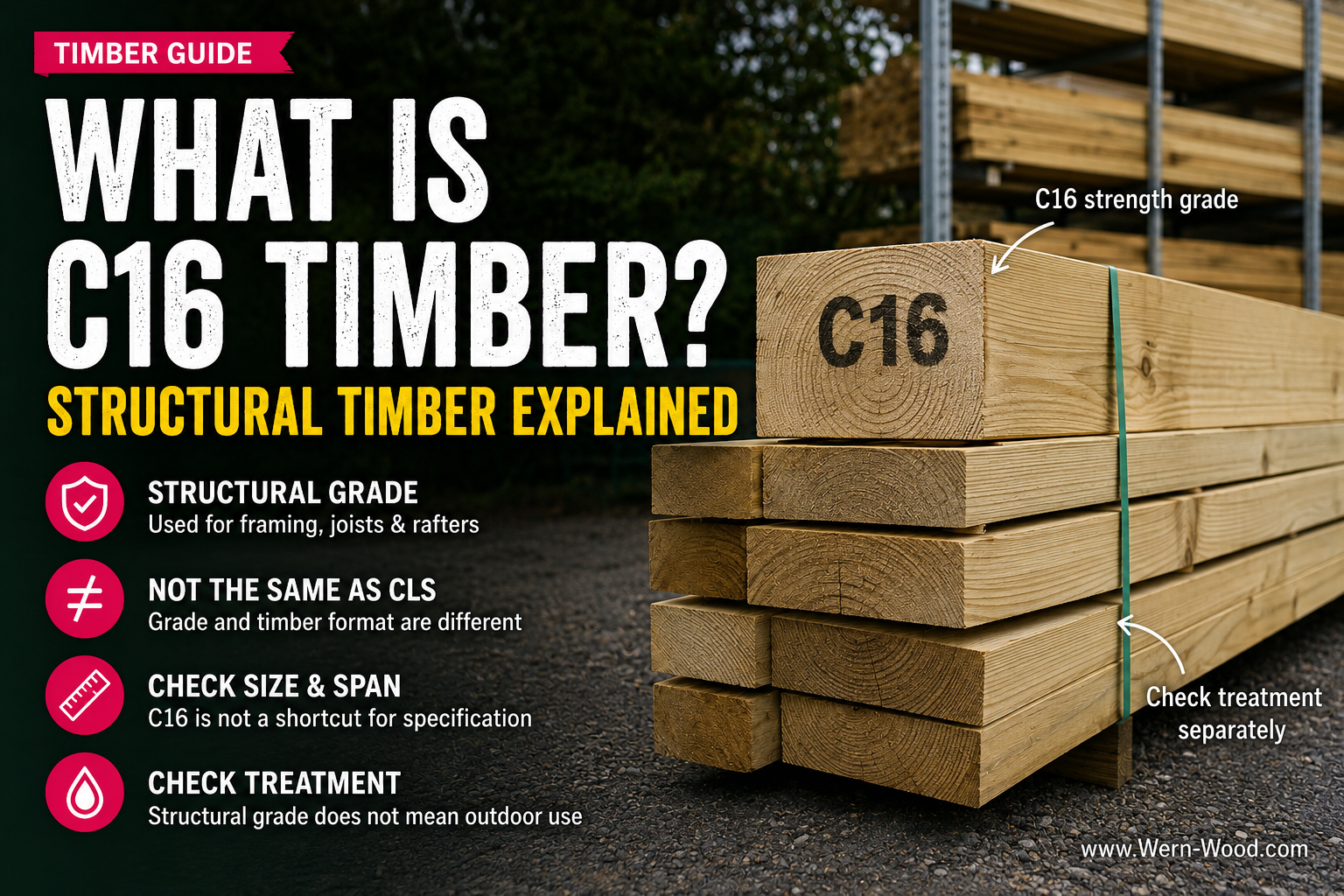
C16 timber is a structural softwood strength class commonly used in the UK for general construction, joists, rafters, studwork, framing and carcassing. The “C” means coniferous softwood, and the “16” refers to the strength class. C16 is suitable for many everyday building jobs when the size, span, spacing, load and treatment are correct. The mistake is assuming C16, C24, CLS and treated timber are interchangeable. They are not.
C16 timber is one of those terms that appears everywhere in building work, but still causes confusion. Customers see it stamped on timber and assume it answers every question. It does not.
C16 tells you the timber has been strength graded into a recognised structural class. It does not tell you whether the size is right for the span, whether the timber is treated for outdoor use, whether it suits the loading, or whether the job should have been specified as C24 instead.
In other words, C16 is a useful structural grade. It is not a shortcut around proper specification.
What is C16 timber?
C16 timber is strength-graded softwood used for structural applications. It is commonly used for load-bearing and framing work where the design allows for that grade.
The “C” stands for coniferous timber, meaning softwood such as spruce, pine or fir. The number refers to the strength class. C16 and C24 are two of the main structural softwood grades seen in UK construction.
The key point is that C16 is not just ordinary sawn timber. It has been graded so it can be used where structural performance matters.
- Structural softwood grade
- Common in UK construction
- Used for joists and framing
- Needs correct span and sizing
- Not the same as CLS
- Not always suitable outside
What is C16 timber used for?
C16 is widely used across domestic building and general construction. It is often the practical choice where the job needs structural softwood but does not necessarily need the higher strength class of C24.
Common uses include:
- Floor joists where the span, spacing and load allow for C16.
- Roof rafters and roof timbers where specified correctly.
- Stud walls and partitions where structural grade timber is required.
- Timber framing and carcassing for general building work.
- Garages, sheds and garden buildings where the design suits the grade.
- First-fix construction where graded timber is required.
For general building timber, start with Structural Timber. For internal studwork and clean framing, CLS Timber may be the better category to browse.
Do not buy structural timber by saying “4x2 will do”. The grade, section size, span, spacing and job all work together. The right question is not only “is it C16?” It is “is this size and grade right for what I am building?”
C16 timber vs C24 timber
C16 and C24 are both structural softwood strength classes. C24 is the higher strength class and is often chosen where longer spans, higher loads or tighter design requirements are involved.
That does not mean C24 is always the better buy. For many everyday jobs, C16 is perfectly suitable when specified correctly. Overspecifying timber can add cost without solving a real problem. Under-specifying timber can create structural risk. The design decides.
| Question | C16 timber | C24 timber |
|---|---|---|
| Strength class | Structural softwood strength class commonly used for general construction. | Higher structural softwood strength class. |
| Typical use | Many everyday joists, rafters, studs, framing and carcassing jobs. | Longer spans, higher loads or where drawings/specifications call for it. |
| Buying mistake | Using it where C24 or a different section has been specified. | Buying it automatically when the job does not need the higher grade. |
| Best approach | Use where the design, span and application suit C16. | Use where the design, engineer, span table or specification requires it. |
Is C16 strong enough?
Sometimes, yes. Sometimes, no. The answer depends on span, spacing, load, section size, support, use and whether the timber is part of a regulated structural design.
A short joist span and a long joist span are not the same job. A lightly loaded stud wall and a roof member are not the same job. Two pieces of timber with the same grade but different sizes will not perform the same way.
If the timber is being used for a load-bearing floor, roof, lintel support, structural frame or any work covered by drawings, calculations or Building Control, follow the specification. If in doubt, speak to a structural engineer, designer or competent professional.
Is CLS timber the same as C16 timber?
No. This is a common mix-up.
CLS describes a timber format and finish. It is commonly used for studwork and internal framing because it is planed, has eased edges, and is easier to handle than rougher carcassing timber.
C16 describes a structural strength class. Some CLS timber may be strength graded, but CLS and C16 are not the same type of term.
| Term | What it means | Buying point |
|---|---|---|
| CLS | A common dressed timber format used for studwork and framing. | Useful for clean internal framing and partitions. |
| C16 | A structural softwood strength class. | Useful where the job needs strength-graded timber and C16 is suitable. |
| C24 | A higher structural softwood strength class. | Use where higher strength or the specification requires it. |
| Treated structural timber | Structural timber treated for specific exposure conditions. | Consider where moisture or external exposure is involved. |
If you are building internal stud walls, browse CLS Timber. If you are buying for joists, rafters, carcassing or construction framing, start with Structural Timber.
Can C16 timber be used outside?
The grade C16 tells you about structural strength. It does not automatically tell you the timber is suitable for outdoor exposure, wet conditions or ground contact.
For external use, you need to check treatment and use. A piece of C16 timber used inside a dry building and a piece used outside in a damp frame are not facing the same conditions.
If timber is exposed to weather, close to damp ground, in contact with soil, or used in a position where failure matters, check the product specification carefully before fitting.
C16 tells you the structural strength class. It does not mean the timber is suitable for every outdoor, damp or ground-contact job. For external or treated use, check the treatment and product suitability separately.
What should you buy for each job?
Use the project to guide the timber choice. The grade is only one part of the decision.
| Job | What to check | Wern-Wood starting point |
|---|---|---|
| Internal stud wall | Stud size, centres, wall height, board type and whether the wall is loadbearing. | CLS Timber |
| Floor joists | Span, spacing, load, section size and grade required by the design. | Structural Timber |
| Roof timbers | Span, roof load, support, specification and Building Control requirements. | Structural Timber |
| Garden building or shed frame | Structural design, exposure, treatment and whether the timber will stay dry. | Construction & Joinery |
| Outdoor framing | Moisture exposure, treatment, ground contact, structural use and fixings. | Treated Sawn Timber |
Common mistakes when buying C16 timber
- Assuming C16 and C24 are interchangeable — use the grade shown on the drawing or specification.
- Buying by size alone — grade, span and spacing matter as much as section size.
- Using CLS and C16 as if they mean the same thing — one describes format, the other describes strength class.
- Using internal timber outside — structural grade is not the same as treatment for exposure.
- Ignoring span tables or engineering — especially for floors, roofs and load-bearing work.
- Overbuying higher-grade timber without reason — C24 is not automatically necessary for every job.
- Under-specifying because “it looks strong enough” — timber choice should follow the job, not a guess.
Before you order C16 timber
Before adding structural timber to your basket, check:
- What is the timber doing? Joist, rafter, stud, frame, roof member or general carcassing?
- Is it load-bearing? If yes, follow the design or get proper advice.
- What grade is specified? C16, C24 or another grade?
- What section size is required? Do not guess from old timber or rough dimensions.
- What span and spacing are involved? These change what timber is suitable.
- Will it be used inside or outside? Treatment and exposure matter.
- Do you also need fixings, hangers or other structural hardware?
For structural softwood, browse Structural Timber. For studwork and internal framing, browse CLS Timber. For wider building supplies, start with Construction & Joinery.
FAQs
What does C16 timber mean?
C16 is a structural softwood strength class. The “C” stands for coniferous softwood, and the “16” refers to the defined strength class used for structural timber.
Is C16 timber structural?
Yes. C16 is a structural timber grade used for load-bearing and framing applications where the design allows for that grade.
What is C16 timber used for?
C16 timber is commonly used for joists, rafters, studs, framing, carcassing and general construction work. The exact use depends on section size, span, load, spacing and specification.
Is C16 timber strong enough for floor joists?
It can be, but only where the span, spacing, load and section size suit C16. Do not guess floor joist sizes. Follow span tables, drawings, Building Control requirements or an engineer’s design.
What is the difference between C16 and C24 timber?
C24 is the higher strength class. It is often used for longer spans, higher loads or where the specification requires it. C16 is widely used for general structural work where suitable.
Is CLS timber the same as C16?
No. CLS describes a dressed timber format commonly used for studwork and internal framing. C16 describes a structural strength class. Some CLS timber may be strength graded, but the terms are not interchangeable.
Can C16 timber be used outside?
Only if the specific product is suitable for the exposure. C16 tells you the strength class, not whether the timber is treated for outdoor, damp or ground-contact use.
Summary: C16 is a grade, not the whole specification
C16 timber is a common structural softwood grade used across UK building work. It is practical, widely used and suitable for many everyday jobs when the size, span, spacing, loading and treatment are correct.
The mistake is treating C16 as the only thing that matters. It is one part of the specification. The job decides whether C16 is enough, whether C24 is required, whether CLS is more suitable, or whether treated timber is needed.
Choose the timber around the job, not just the stamp.
Choosing timber for a building job?
Start with the job: joists, rafters, studwork, framing or general construction. Then choose the correct grade, size, treatment and fixings for the specification.
Shop Structural Timber → Order online or collect from our Briton Ferry yard. Yes, we deliver.Sources checked: Timber Development UK guidance on C16 and C24 timber; GOV.UK Timber in Construction Roadmap 2025. This article is general guidance only and is not a structural design specification. For load-bearing work, regulated building work, floors, roofs, structural frames or engineered spans, follow the drawings, span tables, Building Control guidance or a competent structural engineer’s specification.