Quick answer: neither OSB nor plywood is automatically better. For roof decking, wall sheathing, sheds and general structural sheet work, OSB3 is often the practical, cost-effective choice where the specification allows it. Plywood gives you a much wider choice of grades and finishes, so it becomes the better option when you need a particular plywood specification, a cleaner visible finish, marine plywood, birch plywood or another specialist sheet.
The useful question is not “which board wins?” It is “what does this job actually need?”
What is the difference between OSB and plywood?
OSB — oriented strand board — is made from engineered wood strands arranged and bonded into a structural panel. Our standard construction board is OSB3, which is intended for structural use in humid conditions.
Plywood is built from layers of timber veneer, normally laid with alternating grain directions. “Plywood” is a family of products rather than one specification: structural hardwood, general-purpose hardwood, birch, marine, shuttering and phenolic plywood can all behave differently.
OSB vs plywood at a glance
| What matters | OSB3 | Plywood |
|---|---|---|
| General construction | Often a very practical choice for decking, sheathing and general structural sheet work where OSB3 is specified or suitable. | Structural plywood is also used in construction, but the individual plywood grade and declaration matter. |
| Visible finish | Usually chosen for function rather than appearance. | Birch and selected hardwood plywood can give a much cleaner visible face and edge. |
| Moisture | OSB3 is moisture resistant for humid conditions, not waterproof. | Varies substantially. General-purpose, structural, marine and phenolic plywood should not be treated as one moisture grade. |
| Specialist options | Main choice is grade, thickness and edge profile, such as square edge or T&G. | Much wider product family: marine, birch, shuttering, phenolic, structural and general-purpose. |
| Cost | Often the more economical structural sheet for straightforward construction work. | Can cost more, especially birch, marine and specialist plywood. |
When would we use OSB3?
OSB3 makes sense when you need a strong construction sheet and the face is not the finished decorative surface. Typical Wern-Wood jobs include:
- Shed roof decks.
- Roof decking beneath a suitable weatherproof covering.
- Wall sheathing and general boarding.
- Loft boarding and storage decks where the board thickness, loading and support arrangement are suitable.
- Floor and deck applications where the project specification permits OSB3.
Our square-edge OSB3 is available in 9mm, 11mm and 18mm. We also stock an 18mm OSB3 Tongue & Groove Board where an interlocking edge is useful across a continuous deck.
When would we use plywood instead?
Choose plywood when the job benefits from a specific plywood construction, specification or finish.
- Furniture and cabinetry: Birch Plywood gives a cleaner finish than OSB and is much more suitable when the board itself will be seen.
- Dry internal joinery: General Purpose Hardwood Plywood works well for shelving, boxing and utility work where a structural grade is not required.
- Specified structural plywood: use our Structural Hardwood Plywood where its declared EN specification matches the job.
- Marine plywood: choose BS 1088 Marine Plywood where that marine specification is justified.
- Formwork and site use: Shuttering Plywood is designed around utility rather than furniture finish.
- Anti-slip surfaces: Phenolic Birch Plywood gives a film-faced, textured surface for suitable floors and platforms.
Is plywood stronger than OSB?
That question is too broad to answer from the material name alone. Strength and stiffness depend on the specific board, thickness, direction, grade, span, support arrangement and loading.
An 18mm board is not automatically suitable for a floor or roof simply because it is 18mm. For structural work, use the sheet type, thickness, supports and fixings required by the project rather than choosing from a generic “OSB is stronger” or “plywood is stronger” rule.
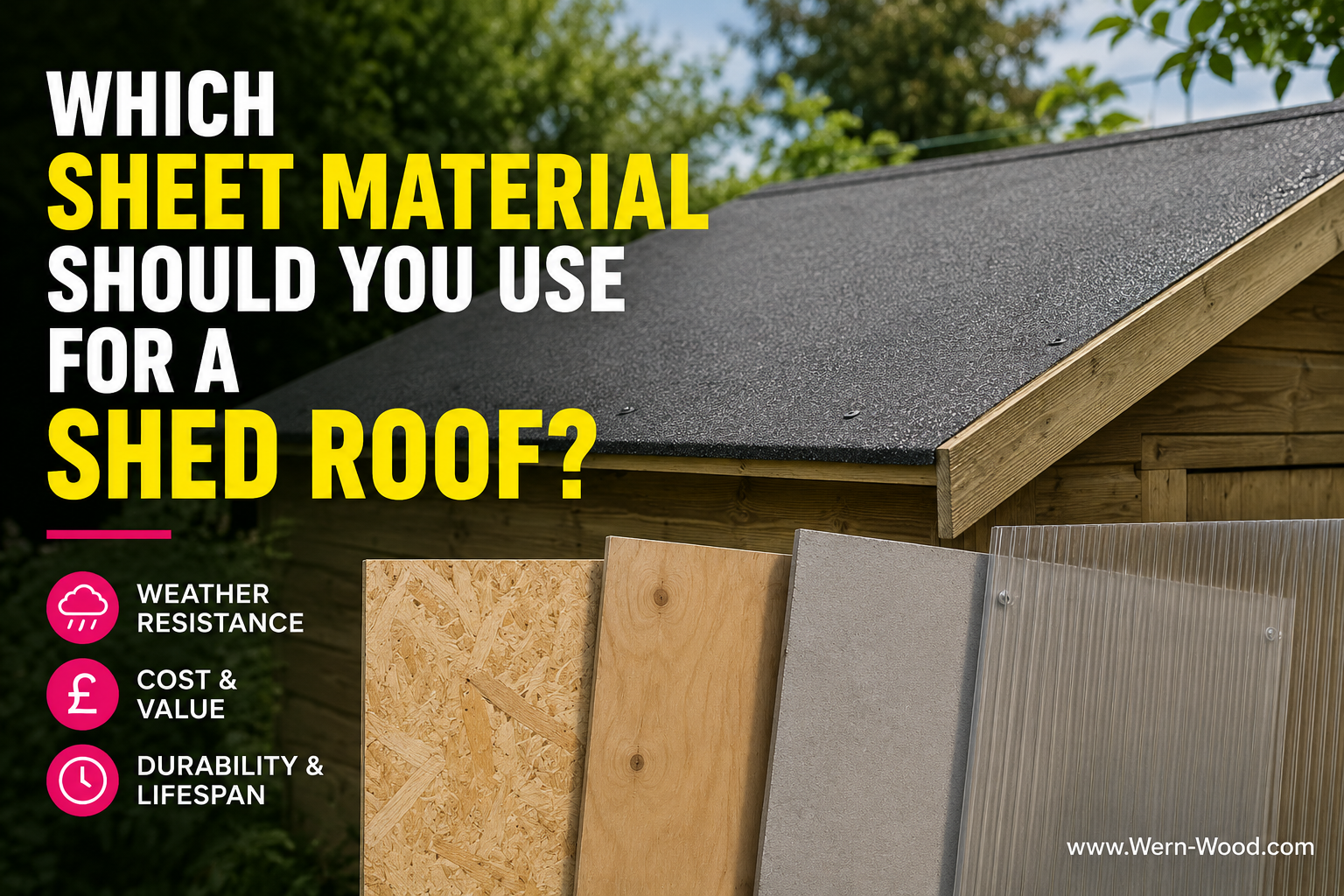
Which is better for a shed roof?
For most normal garden shed roofs, we usually point customers towards OSB3 because it is a practical roof-deck material and normally costs less than buying a specialist plywood that the job does not need.
The roof deck is not the waterproof layer. OSB3 must still be correctly supported and covered with the specified felt, EPDM or other roofing system.
For the full project-specific comparison, read Which Sheet Material Should You Use for a Shed Roof?
Which is better for furniture?
Plywood normally makes more sense if the sheet will remain visible. Birch plywood in particular gives a much cleaner face and edge for furniture, cabinetry and joinery.
OSB can of course be used deliberately as a visible design material, but that is an aesthetic choice rather than a like-for-like substitute for a finished birch plywood panel.
Which handles moisture better?
Again, compare the exact products rather than “OSB” with “plywood”. OSB3 is intended for structural use in humid conditions but is not waterproof. Plywood can range from dry internal general-purpose board to marine plywood and exterior bond classifications.
If moisture exposure is the deciding issue, read Is Plywood Waterproof? Which Plywood Can Be Used Outside? before choosing the sheet.
Is Sterling board the same as plywood?
No. “Sterling board” is a name many UK buyers use when referring to OSB-type board. It is not plywood. If someone asks us for Sterling board, the useful next question is usually whether they mean an OSB3 construction sheet and what thickness and application they need.
The simplest way to choose
- Hidden construction sheet, roof deck or sheathing: start with OSB3.
- Visible furniture/joinery: start with birch or suitable hardwood plywood.
- Specific structural plywood requirement: match the plywood declaration to the specification.
- Marine specification: use BS 1088 marine plywood.
- Anti-slip face: use phenolic plywood.
You can compare all of our Plywood Sheets and OSB3 Boards online.