Quick answer: Choose a tower bolt for a simple, compact sliding bolt on a gate, door or shed. Choose a Brenton bolt when you want a larger traditional surface-mounted gate bolt. Choose a spring-loaded bolt when spring pressure is useful for keeping the bolt engaged. A bolt holds or secures the gate; it does not normally replace the everyday handle and latch.
Tower bolts, Brenton bolts and spring-loaded bolts can look similar in a product list because they all use a moving bolt. They are not identical. The right choice depends on how the gate is used, where the bolt must engage and whether the bolt is the everyday fastener or an additional restraint.
Tower, Brenton and spring-loaded bolts compared
| Bolt | How it works | Best reason to choose it |
|---|---|---|
| Tower bolt | A straight sliding bolt moves into a keeper fixed to the frame, post, floor or adjoining gate leaf. | A simple and economical way to hold a gate, shed door or access panel closed. |
| Brenton bolt | A larger surface-mounted slide bolt moves horizontally or vertically into its keeper. | A traditional gate-style bolt where a more substantial body and longer bolt are preferred. |
| Spring-loaded bolt | A spring acts on the bolt to help keep it in its working position. | Useful where spring pressure helps maintain engagement on a gate, door, hatch or animal-housing application. |
What is a tower bolt used for?
A tower bolt is a straightforward surface-mounted fastening. Slide the bolt into its keeper to hold the gate or door closed, then pull it back to release it.
It can be fitted horizontally into a post or frame, or vertically where the bolt needs to engage with a suitable floor or ground receiver. The correct orientation depends on the bolt design and the job.
Our Eliza Tinsley Tower Bolt range includes several lengths and finishes. It is a practical choice for:
- Light and general-purpose garden gates
- Shed and outbuilding doors
- Cupboard and access doors
- The inactive leaf of a suitable pair of doors or gates
A tower bolt is usually selected for simple restraint rather than because the product itself provides a full security solution.
What is a Brenton bolt used for?
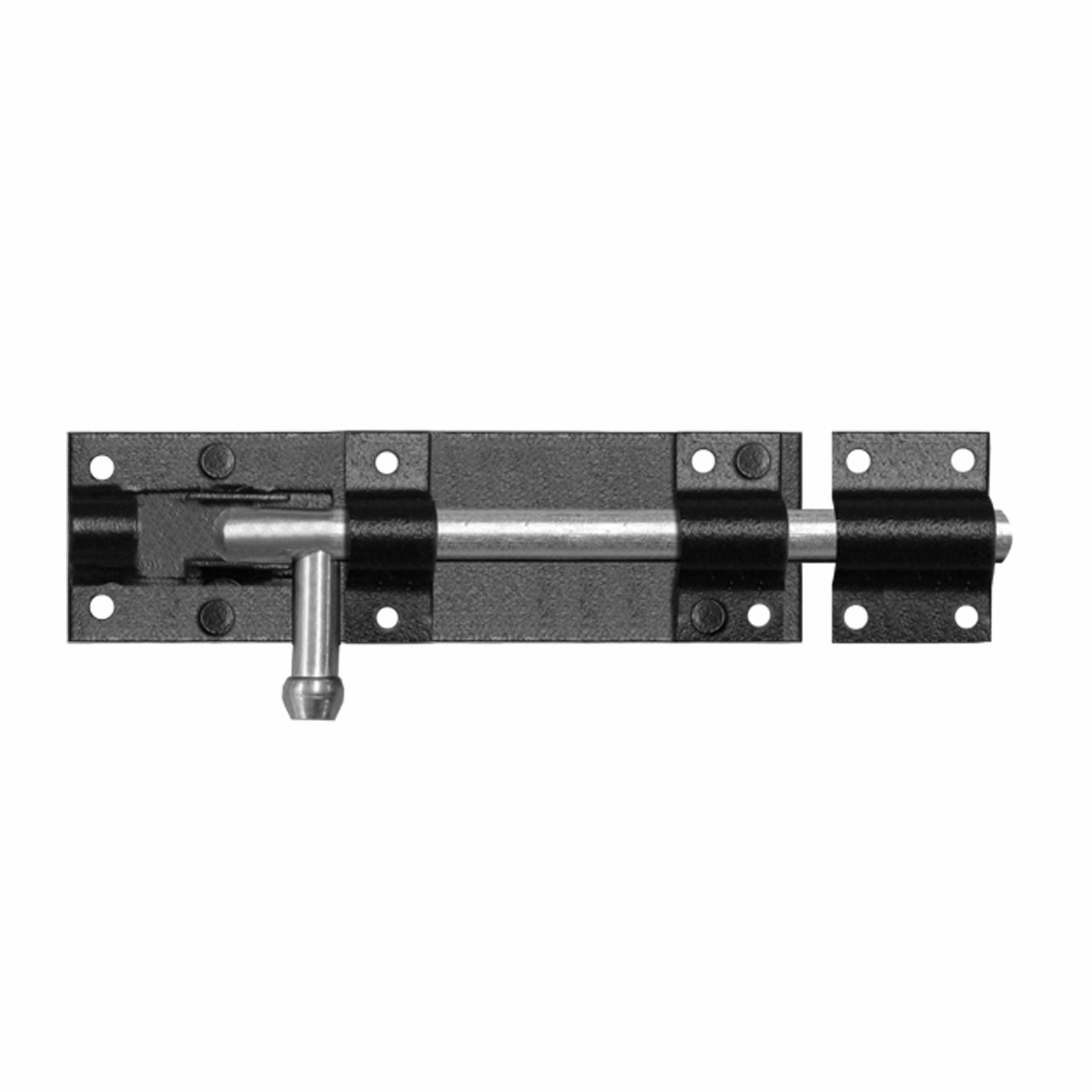
A Brenton bolt is another surface-mounted sliding bolt, but it is commonly associated with timber gates, shed doors and outdoor buildings. Its larger format gives it the familiar appearance of traditional gate hardware.
Our Brenton Bolt is available in 150mm and 200mm lengths with black or galvanised finish options.
Choose a Brenton bolt when:
- You want a larger traditional gate bolt
- The bolt needs to span the available gap to a suitable keeper
- The gate has solid timber where the full body and keeper can be fixed
- You want the bolt to match other black or galvanised gate hardware
Do not assume every Brenton bolt is lockable. Padlock provision depends on the exact bolt design. Check the product itself before relying on it as a locking fitting.
What is a spring-loaded bolt used for?
A spring-loaded bolt uses spring pressure to help keep the moving bolt engaged. This can be useful where vibration, movement or repeated use might otherwise allow an ordinary loose bolt to move from its intended position.
The Eliza Tinsley Spring Loaded Bolt is suitable for compatible gates, doors, hatches, animal housing and access panels.
Choose a spring-loaded bolt when:
- You specifically need the spring action
- The receiver can be accurately positioned
- The gate or door has solid material for the fixing screws or bolts
- The bolt arrangement remains easy and safe to release
Do you still need a latch?
Often, yes. A latch is normally used every time someone opens or closes the gate. A bolt may be an additional fitting used at night, when the gate is not in use, or to secure the inactive leaf of a double arrangement.
For an everyday opening fitting, compare ring gate latches, Suffolk latches and automatic gate latches in our gate latch guide.
What about a hasp and staple?
A hasp and staple is the clearer choice when the main requirement is to use a separate padlock. It is different from an everyday latch and should be positioned so the hasp, staple, padlock and fixings are all suitable for the level of security required.
What about a cabin hook?
A cabin hook performs the opposite everyday job: it normally holds a gate or door open. It should not be confused with a bolt intended to hold the gate closed or a fitting intended to provide security.
Common gate-bolt mistakes
Fitting the keeper before checking alignment
Hang and align the gate first. Position the keeper only when the bolt can enter it cleanly without forcing the gate up, down or sideways.
Fixing into weak face boards
The body and keeper should be fixed into solid timber or another suitable substrate. Thin boards alone may not provide enough fixing depth.
Using the bolt to pull a twisted gate into shape
A bolt should retain an aligned gate. It should not be used as a lever to correct warped timber, failed hinges or a moving post.
Assuming a closed gate is a secure gate
A simple slide bolt may prevent casual opening but is not automatically a security lock. Use a suitable locking product where security matters.
Which bolt should you buy?
Choose a tower bolt for a compact, simple slide bolt. Choose a Brenton bolt for a more substantial traditional gate fitting. Choose a spring-loaded bolt where the spring action is genuinely useful. For padlocking, consider a hasp and staple rather than assuming any slide bolt is lockable.
See the full wooden garden gate hardware guide to combine the bolt with the correct hinges, latch and handle, or browse all gate bolts.