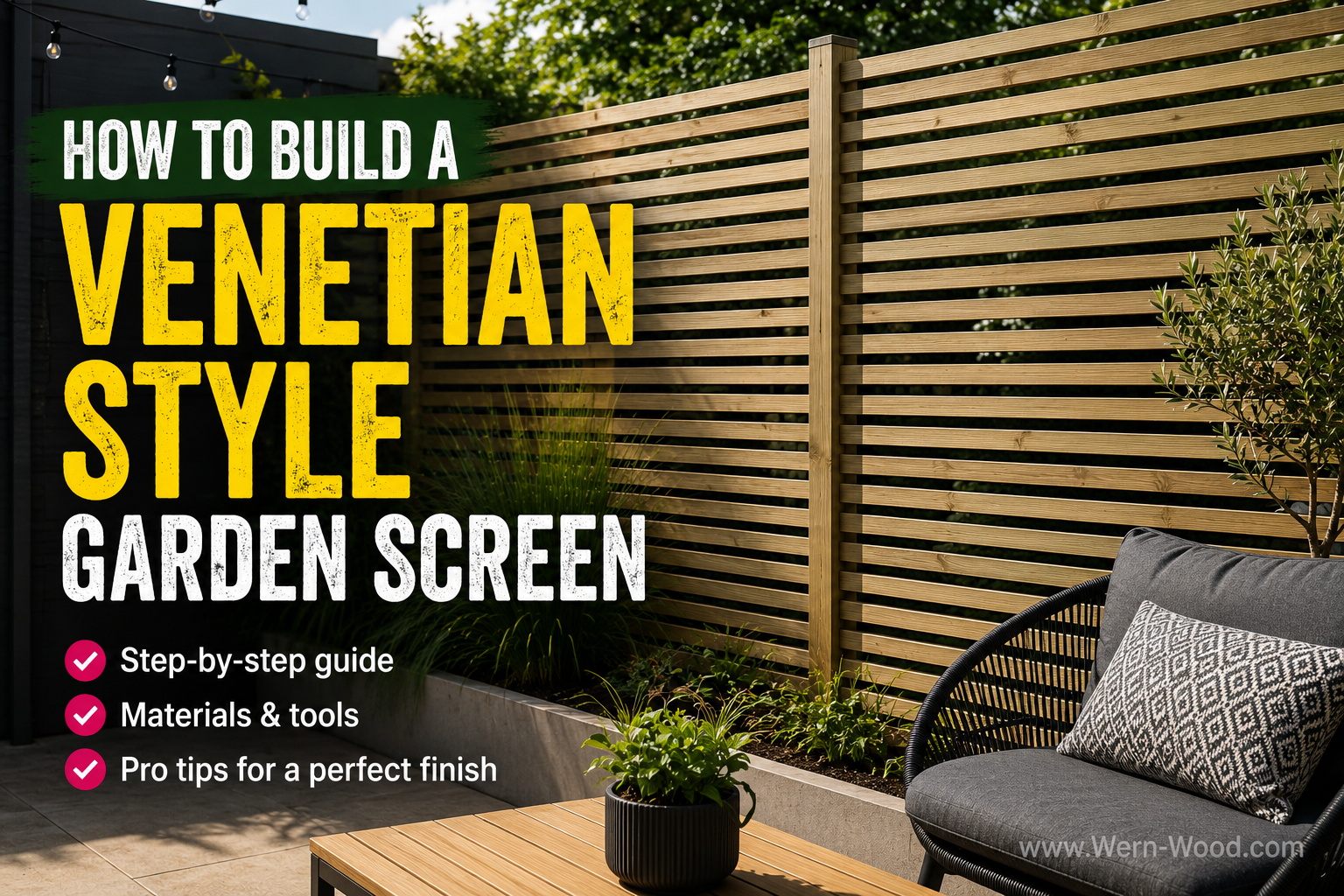
A Venetian-style garden screen is normally a one-sided horizontal slatted screen. The landscaping battens are fixed across the posts and intermediate supports with a consistent gap between them. The result can be fairly private with a small gap, or deliberately more open where the aim is visual separation rather than a solid boundary.
This guide uses the layout we would normally discuss with a Wern-Wood customer: posts around 6ft (1.8m) apart, with an intermediate support at about 3ft (0.9m) so the battens are supported halfway across the bay.
What you need
- Rounded-edge treated landscaping battens
- Treated fence posts
- Intermediate vertical support pieces
- Suitable exterior-rated timber fixings
- Postmix or the fixing system required by your post installation
- A spacer block cut to the gap you want
- Level, line and basic measuring/cutting tools
- Optional black weed membrane if you want a dark privacy backing
1. Decide how private you want the screen
Choose the gap before working out your quantities. Wern-Wood's practical starting points are:
- About 10mm: privacy first.
- 10–20mm: common for fencing.
- 15–30mm: useful for screens and visual separation.
Larger gaps admit more light but make it easier to see through the screen. There is no benefit in copying somebody else's spacing if they wanted a different level of privacy.
If you are not sure whether a one-sided screen is the right layout, read Timber Garden Privacy Screens – Slatted, Venetian or Hit-and-Miss? first.
2. Set the posts
For this type of batten screen, we normally use posts at roughly 6ft centres. Set them straight, plumb and in line because any error becomes obvious when the horizontal battens are fitted across them.
A common rule of thumb is around one third of the post length in the ground, but that is only a starting point. Fence height, exposure and ground conditions affect the job. Use our fence post depth guide for the fuller explanation.
3. Add an intermediate support halfway across the bay
With posts around 6ft apart, add a vertical intermediate support at roughly 3ft. The battens still run directly across the face of the posts; the middle support gives them another fixing point and helps hold a consistent line and spacing.
The intermediate piece is not a substitute for a properly installed fence post. Its job here is to support the slats between the main posts.
4. Add membrane now if you want a dark privacy backing
If you want the slatted appearance but do not want a direct view through the gaps, black weed membrane can be fitted as a backing before the battens go on.
This creates a much more closed visual effect. It also changes the airflow and appearance compared with an open slatted screen, so leave it out where the open screen is the point.
5. Fix the first batten level
Start with a straight, level first batten. Every slat above it follows that line, so spend the time getting the first one right.
Fix the batten to the posts and the intermediate support using suitable exterior fixings. Pre-drill near the ends where splitting is a risk.
6. Use one spacer block for the whole screen
Cut a spacer to the exact gap you chose at the planning stage. Use that same spacer between every batten rather than measuring each gap individually.
For example, if privacy is the priority, a 10mm spacer gives a much tighter screen than a 30mm spacer. The timber is the same; the visual result comes from the spacing.
7. Keep checking the line as you work up
Do not assume the spacer alone will keep the screen level. Check the battens periodically with a level or line and correct any drift before it becomes obvious across the whole bay.
8. Treat fresh cut ends where required
If you cut pressure-treated battens to length, follow the treatment/product guidance for protecting freshly exposed cut ends before installation.
How many battens do you need?
The quantity depends on the screen dimensions, batten profile and chosen gap. Use the Landscape Batten Calculator once those decisions are made, and allow sensible contingency for cuts and defects rather than treating the calculated figure as a guarantee that every job will use exactly that number.
When a Venetian screen is not the right layout
A one-sided screen is normally the simpler route when only one face needs to look finished and you want a semi-open slatted effect. If you need both faces finished and want to remove the direct line of sight through the gaps, use a double-sided hit-and-miss layout instead.
Shop the timber in Landscaping & Screening Battens or go directly to the rounded-edge landscaping batten.