Your Decking Boards Are Not Usually the First Thing to Fail
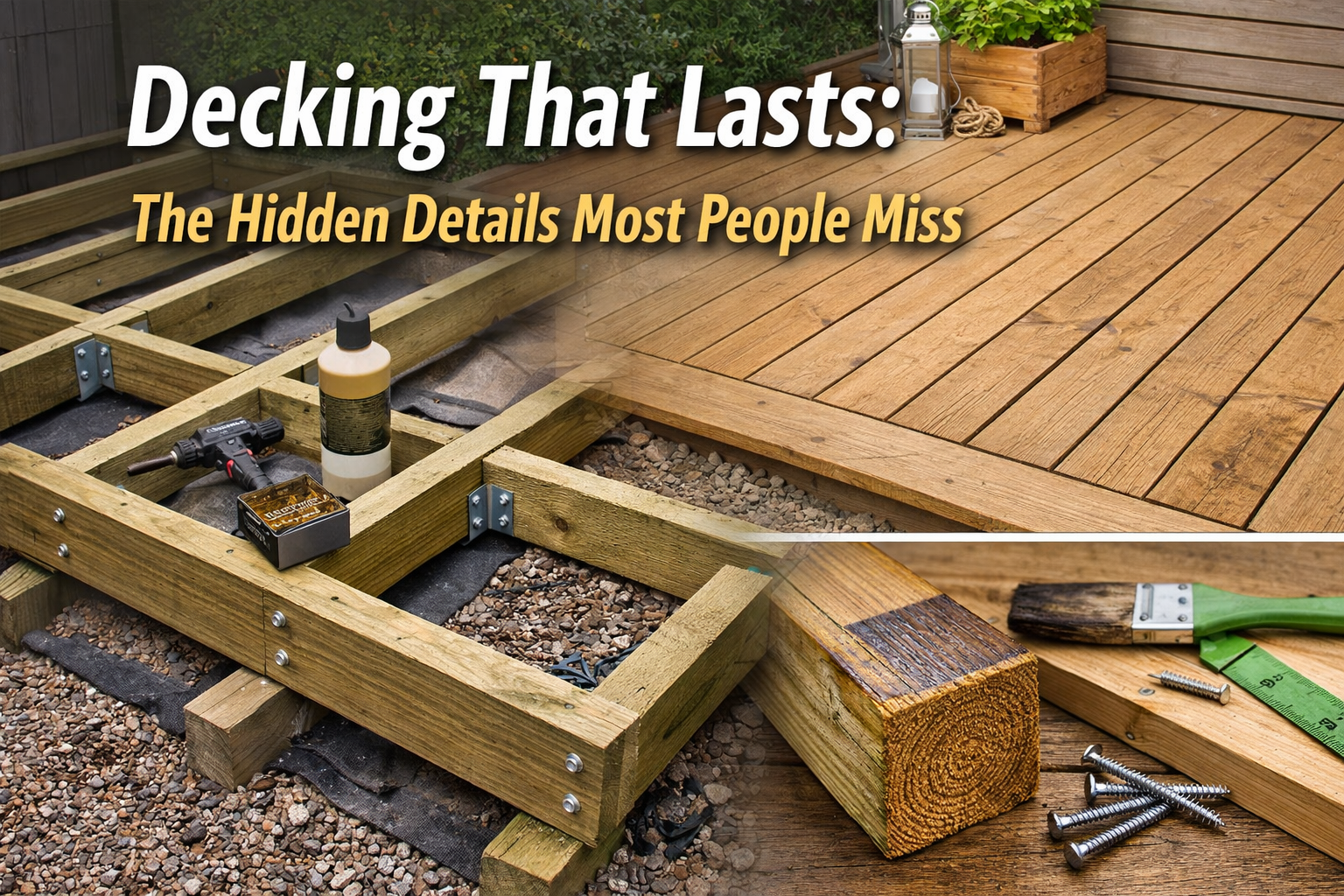
To make timber decking last longer, focus on the details underneath: a suitable treated subframe, good airflow, drainage, correct joist spacing, exterior-rated fixings, protected cut ends, and consistent gaps between boards. In the UK, most decking problems are moisture problems. A deck that traps water underneath, sits too close to damp ground, uses poor fixings or leaves cut ends exposed can fail early even if the boards looked good when fitted.
A deck can look excellent on day one and still be built in a way that shortens its life.
That is because the visible boards are only part of the job. The frame, fixings, gaps, drainage, ground clearance and end-grain treatment all decide how well the deck handles wet UK weather over time.
If you want decking that lasts, do not start by asking only “which board looks best?” Start by asking what will happen when rainwater gets underneath it, leaves sit in the gaps, the frame stays damp, and the fixings have to hold everything together through winter.
1. The frame matters more than the boards
The deck boards are what everyone sees. The frame is what keeps the deck usable.
If the frame stays damp, sits too close to wet ground, has poor airflow, uses the wrong timber, or traps water at joints, it can deteriorate before the boards look worn out. That is why a long-lasting deck starts with the substructure.
For decking frames, choose timber that suits the exposure and the design. A deck subframe is not the same job as a dry internal stud wall. It needs timber suitable for outdoor structural use, plus proper drainage and fixing details.
Customers often spend the most time choosing the visible deck board. Builders usually worry about the frame first. If the frame fails, the boards are coming up no matter how good they looked.
For decking boards, start with Timber Decking. For the frame and supporting timber, browse Treated Structural Timber.
2. Airflow underneath is not optional
Timber lasts longer when it can dry between wet spells. If the deck is built too close to damp soil, boxed in with no ventilation, or packed underneath with debris, moisture has nowhere to go.
That is when problems start from below: rot, mould, soft joists, movement, musty smells, loose fixings and a deck that feels tired long before it should.
- Avoid building directly onto soil or grass without a proper base.
- Keep the underside ventilated so damp air can move away.
- Clear leaves and debris from under and around the deck.
- Use a free-draining base where appropriate, such as compacted stone or gravel.
- Think carefully about very low decks, because airflow is harder to achieve.
Low-level decking is not automatically easier. The closer the frame sits to damp ground, the more important ventilation, drainage and timber specification become.
3. Drainage decides whether timber dries or stays wet
Rot and decay usually begin where water is repeatedly held against timber. That can happen on the surface, inside board gaps, at cut ends, around joist tops, at wall junctions or where the deck is built over poor drainage.
Look for the places water could sit and design them out before building:
- Avoid dips in the frame where water can collect.
- Do not trap timber tight against walls without a suitable gap and airflow.
- Keep board gaps open so water can drain through.
- Do not allow soil or mulch to build up against timber edges.
- Consider joist-top protection where water may sit on horizontal timbers.
- Direct downpipes and garden runoff away from the deck where possible.
Many decking problems are really drainage problems that only show themselves after a few wet seasons.
4. Joist spacing affects bounce, movement and fixing stress
A bouncy deck is not only annoying. It can stress the boards and fixings every time someone walks across it.
Correct joist spacing depends on the decking board, board thickness, timber species, loading and manufacturer guidance. Some boards need closer centres than others. Composite boards, thinner boards, diagonal layouts and high-use areas may need different spacing from a basic straight timber deck.
| Decking issue | Often caused by | What to check |
|---|---|---|
| Bouncy deck | Joists too far apart, undersized frame or weak support. | Board guidance, joist centres, span and frame design. |
| Loose boards | Movement, poor fixings or insufficient board support. | Screw type, fixing pattern and joist spacing. |
| Twisting frame | Lack of noggins, blocking or bracing. | Frame layout and lateral stability. |
| Early subframe decay | Trapped moisture and poor airflow. | Ground clearance, drainage and treated timber specification. |
Do not guess joist spacing from habit. Check the decking product and build the frame to suit the board you are actually fitting.
5. Use fixings that belong outside
Decking fixings live in a harsh place: wet timber, changing moisture, repeated movement, foot traffic, and outdoor exposure. Cheap or incorrect screws can rust, stain, snap or lose holding power.
For timber decking, use exterior-rated fixings suitable for the timber and treatment. The TDCA says metal fixings for outdoor timber structures should be corrosion resistant, such as stainless steel, hot-dipped galvanised or specialist coated, and recommends checking suitability with the manufacturer.
- Use decking screws rather than ordinary internal screws.
- Choose corrosion-resistant fixings suitable for outdoor timber.
- Fix boards consistently across the deck.
- Pre-drill where needed, especially near board ends or with harder timbers.
- Use the correct length for the board thickness and joist below.
Browse Decking Screws alongside Timber Decking so the board and fixing suit each other.
6. Protect cut ends and exposed end grain
Cut ends are one of the easiest details to ignore and one of the most important to get right.
When treated timber is cut, drilled, notched or trimmed, fresh timber is exposed. End grain can take in moisture more easily than the face of the board, so it needs protection before installation.
This matters on:
- Cut joists and bearers
- Trimmed decking boards
- Notches and drilled areas
- Posts and support timbers
- Any cut end near damp areas
Brush cut ends of treated decking timbers with a suitable end-grain preservative before installation. Do not leave freshly exposed timber to take in moisture where the treatment has been cut away.
7. Board gaps stop water being trapped
Deck boards need a consistent gap. Too tight and the boards trap water, dirt and leaves. Too wide and the deck can look unfinished or feel uncomfortable underfoot.
TDCA guidance says adjacent deck boards should generally have a gap of 5–8mm. It also notes that board ends should not be butted tightly, and that where a board end meets a post, a 5mm space should be left. Where boards meet a building, TDCA guidance gives a 10mm gap.
| Decking gap | Why it matters | Practical note |
|---|---|---|
| Between boards | Allows drainage and seasonal movement. | TDCA guidance: usually 5–8mm. |
| Board ends | Avoids trapping moisture at end grain. | Do not butt ends tightly. |
| Against posts | Prevents timber being trapped tight to an obstruction. | Leave a small gap. |
| Against buildings | Helps drainage, movement and airflow at the wall junction. | Do not fix boards tight to walls. |
A neat deck is not one with boards jammed together. A neat deck is one with controlled, consistent gaps that help it survive the weather.
8. Decking kits can reduce missed materials
If you want a simpler build with matched components, Timber Decking Kits can be a useful route for straightforward deck shapes.
Kits help reduce the “nearly everything” problem, where a customer buys the boards but forgets fixings, frame timber, support details or finishing items. They are not a substitute for site planning, but they can make the material list easier.
For custom decks, awkward shapes, low-level builds, steps, raised decks or areas near buildings, plan the full material list carefully rather than relying on board quantity alone.
9. Maintenance keeps small problems small
A deck lasts longer when it is kept clean and allowed to dry.
Maintenance does not need to be complicated, but it does need to happen. Most timber decking problems start small: leaves collect, algae builds, gaps block, screws loosen, water sits where it should drain, and the deck stays damp for longer than necessary.
- Sweep leaves and debris from the surface regularly.
- Keep gaps clear so water can drain.
- Clear moss and algae before it builds up.
- Check fixings seasonally and tighten or replace where needed.
- Inspect the frame where accessible, especially around damp or shaded areas.
- Keep planters and furniture from trapping moisture in one place for long periods.
A lot of “bad decking” is really neglected decking. If water cannot drain and air cannot move, timber stays wet longer. That is when small issues turn into expensive ones.
What should you buy for a longer-lasting deck?
A deck is a system. Boards, frame, fixings and preparation all need to work together.
| Part of the deck | Why it matters | Wern-Wood starting point |
|---|---|---|
| Decking boards | The visible walking surface. | Timber Decking |
| Decking frame | The hidden structure that carries the deck. | Treated Structural Timber |
| Decking screws | Hold boards down through weather and movement. | Decking Screws |
| Decking kit | Useful for straightforward matched builds. | Timber Decking Kits |
| Wider outdoor materials | Useful if decking is part of a fencing or landscaping job. | Fencing, Decking & Landscaping |
Common decking mistakes that shorten lifespan
- Focusing only on the boards — the frame often fails first.
- Building too close to damp ground — airflow and drainage matter.
- Ignoring joist spacing — bounce and movement start in the frame.
- Using internal screws outside — fixings must suit outdoor treated timber.
- Leaving cut ends untreated — exposed end grain takes in moisture easily.
- Fitting boards too tight — tight boards trap water and debris.
- Letting leaves sit in gaps — blocked drainage keeps the deck wet.
- Trapping timber tight against walls — allow drainage and movement.
- Not checking the deck after winter — small repairs get missed.
Before you order decking materials
Before adding decking boards to your basket, plan the full build:
- How high will the deck sit above ground?
- Will the subframe have enough airflow?
- What ground preparation is needed underneath?
- What joist spacing does the board require?
- Do you need treated structural timber for the frame?
- Have you chosen suitable decking screws?
- Will cut ends need end-grain preservative?
- How will water drain away from the deck and nearby walls?
- Do you have somewhere suitable to store the timber before fitting?
If you are ordering bulky decking materials, check Delivery Information before checkout so you can plan access, unloading and storage properly.
FAQs
How do I make timber decking last longer?
Use suitable timber, build a well-ventilated frame, avoid trapped water, protect cut ends, use exterior-rated fixings, leave consistent board gaps and keep the deck clean so it can dry between wet spells.
What is the most important part of a deck?
The frame is usually the most important part because it carries the boards and often determines how long the deck lasts. A poor subframe can fail before the decking boards look worn.
Can decking be built directly on soil?
It is better not to build timber decking directly onto soil or grass. A deck needs a stable, free-draining base and enough airflow underneath so the timber can dry.
What gap should I leave between decking boards?
TDCA guidance gives 5–8mm between adjacent timber deck boards. The exact requirement can vary by product, moisture content and manufacturer guidance, so always check the board instructions.
Do cut ends on decking need treating?
Yes. When treated timber is cut, notched or drilled, exposed areas should be protected with a suitable end-grain preservative before installation.
What screws should I use for decking?
Use exterior-rated decking screws suitable for the timber, treatment and exposure. Stainless steel, hot-dipped galvanised or specialist-coated fixings may be suitable depending on the product and environment.
Are decking kits worth using?
Decking kits can be useful for straightforward deck shapes because they help match key materials together. For complex, low-level, raised, stepped or custom decks, plan the full specification carefully.
Summary: build the deck so water can leave
Timber decking lasts longer when the frame is right, the underside can breathe, water can drain away, board gaps are consistent, fixings suit outdoor use and cut ends are protected.
Most early decking problems are not caused by the visible boards alone. They start in the hidden details: poor airflow, trapped moisture, weak framing, wrong fixings and unfinished cuts.
Build those details properly and your deck has a much better chance of staying solid, safe and usable for longer.
Planning a timber decking project?
Do not just order the boards. Plan the frame, screws, airflow, drainage, cut-end treatment and delivery space before you build.
Shop Timber Decking → Order online or collect from our Briton Ferry yard. Yes, we deliver.Sources checked: Timber Decking and Cladding Association guidance on timber decking specification, board gaps and exterior metal fixings; Timber Decking Handbook guidance on cut-end treatment and deck substructure detailing; Wern-Wood live sitemap and decking categories. This article is general decking guidance only. Final specification depends on deck height, ground conditions, board type, span, loading, fixings, manufacturer instructions and whether the deck is domestic, commercial, raised, attached to a building or subject to Building Regulations or planning requirements.