If you’ve spent any time around high-performance builds, Passivhaus discussions, or serious home cinema forums, you’ve probably seen staggered stud walls mentioned. What used to be a detail found mainly in acoustic partitions and low-energy construction is now appearing in domestic renovations and self-build projects. The reason is simple: it reduces thermal bridging and improves sound separation without the full cost or thickness of a double stud wall.
A staggered stud wall is not a gimmick. It is a recognised framing approach used in high-performance partitions to reduce direct structural connection between both faces of a wall. That reduction in direct timber contact is what delivers its benefits.
What is a staggered stud wall?
In a standard stud wall, each vertical stud runs the full depth of the wall, meaning it physically connects one plasterboard face to the other. Sound and heat can transfer directly through those timber members.
A staggered stud wall uses a wider sole plate and head plate (for example, 140mm instead of 89mm), with two rows of studs offset from each other. Studs fixed to one side do not touch the plasterboard on the opposite side. The result is that no single piece of timber bridges both faces of the wall.
The framing timber is typically standard CLS Timber, but arranged in an alternating layout along a wider plate.
Where the idea comes from
The concept originates from acoustic engineering and low-energy construction. In high-performance buildings, designers aim to reduce two major forms of transfer:
- Airborne sound transmission (voices, TVs, music)
- Thermal bridging (heat loss through solid materials)
A continuous timber stud creates both an acoustic bridge and a thermal bridge. By separating the studs, the wall becomes partially decoupled. This principle is widely used in enhanced acoustic partitions, studio builds, and energy-efficient housing.
Acoustic benefits
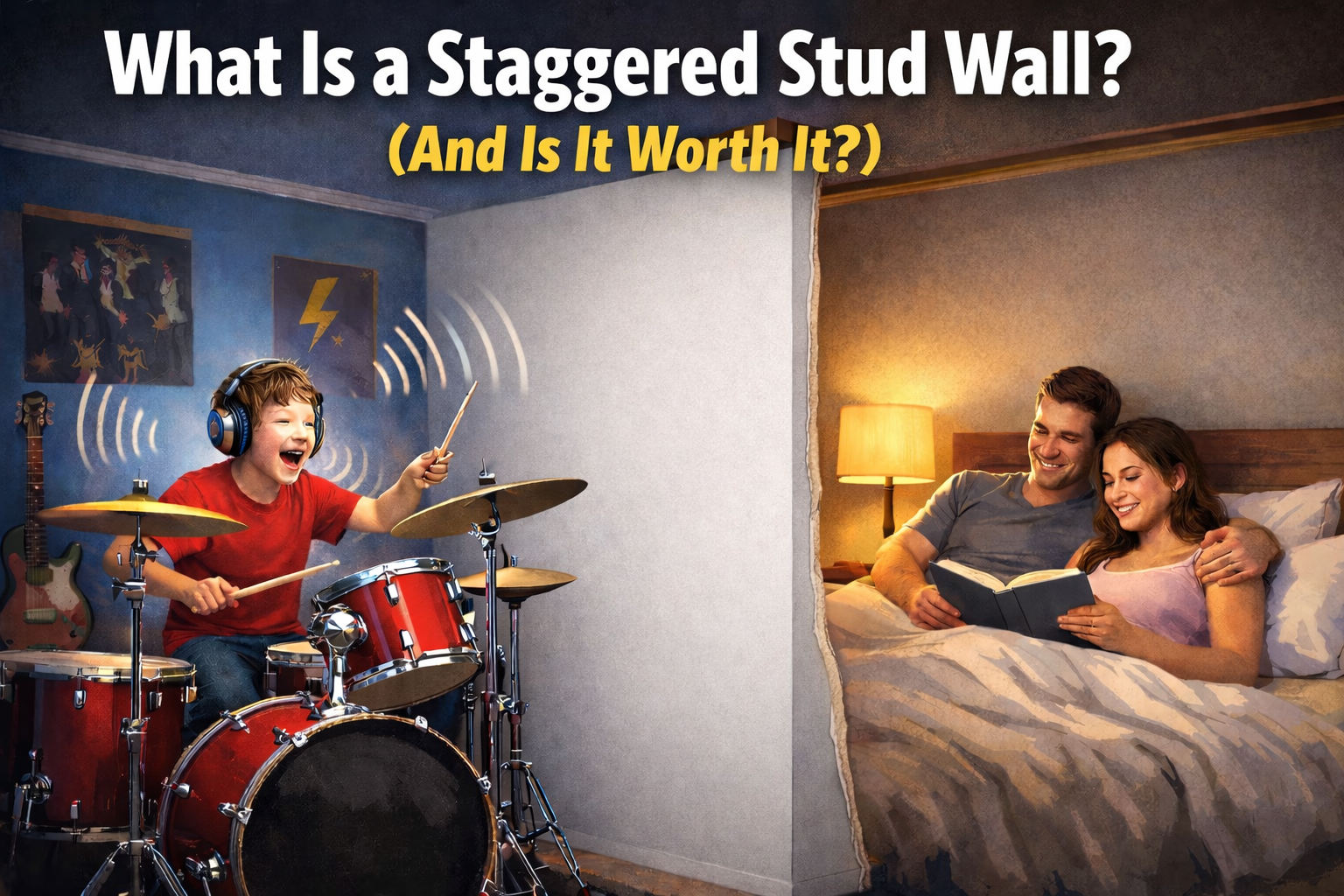
Sound travels effectively through rigid connections. In a standard stud wall, vibration passes through the plasterboard, into the stud, and out through the opposite board. With staggered studs, that direct path is broken. Each face is fixed to a separate row of studs, meaning vibration must travel through the cavity insulation rather than directly through timber.
When combined with appropriate insulation and board layers, a staggered stud wall can significantly improve airborne sound performance compared to a standard single-row stud partition. It does not perform as highly as a full double stud wall (two completely separate frames), but it offers a strong middle ground between performance and material cost.
Thermal performance advantages
Timber conducts more heat than insulation. In standard framed walls, each stud acts as a repeating thermal bridge across the wall depth. In a staggered configuration, insulation can run continuously across the cavity with no single timber member crossing the full wall thickness. This reduces repeating thermal bridges and can slightly improve the effective U-value of the wall assembly.
For high-performance or low-energy builds, this detail can form part of a wider strategy to reduce heat loss through structural elements.
Where it works well
- Home cinemas and media rooms
- Bedrooms separating from bathrooms or living areas
- Flats or annexes where sound separation matters
- Energy-conscious self-build projects
- Office partitions requiring improved acoustic comfort
It is most commonly used in internal partitions rather than primary load-bearing structural walls, unless specifically engineered.
The downsides
A staggered stud wall is not a free upgrade. It requires:
- Wider plates
- More framing timber
- More planning around door openings
- Careful detailing at junctions
The wall thickness increases, which may affect room dimensions. Fixing heavy items requires forethought because not every stud aligns across the wall. It also takes slightly longer to set out and build compared to a conventional stud layout.
Is it better than a double stud wall?
A true double stud wall uses two completely separate frames with an air gap between them. That delivers higher acoustic and thermal separation but at increased cost and wall thickness. A staggered stud wall provides improved performance within a single wider plate, making it a practical compromise.
Should you use one?
For standard internal partitions in typical homes, a conventional stud wall at appropriate centres is usually sufficient. However, if acoustic separation or thermal efficiency is a priority, a staggered stud layout can provide measurable improvement without stepping up to a full double-frame system.
Like many details borrowed from high-performance construction, it is not essential everywhere — but in the right setting, it is a smart upgrade rather than a social media trend.