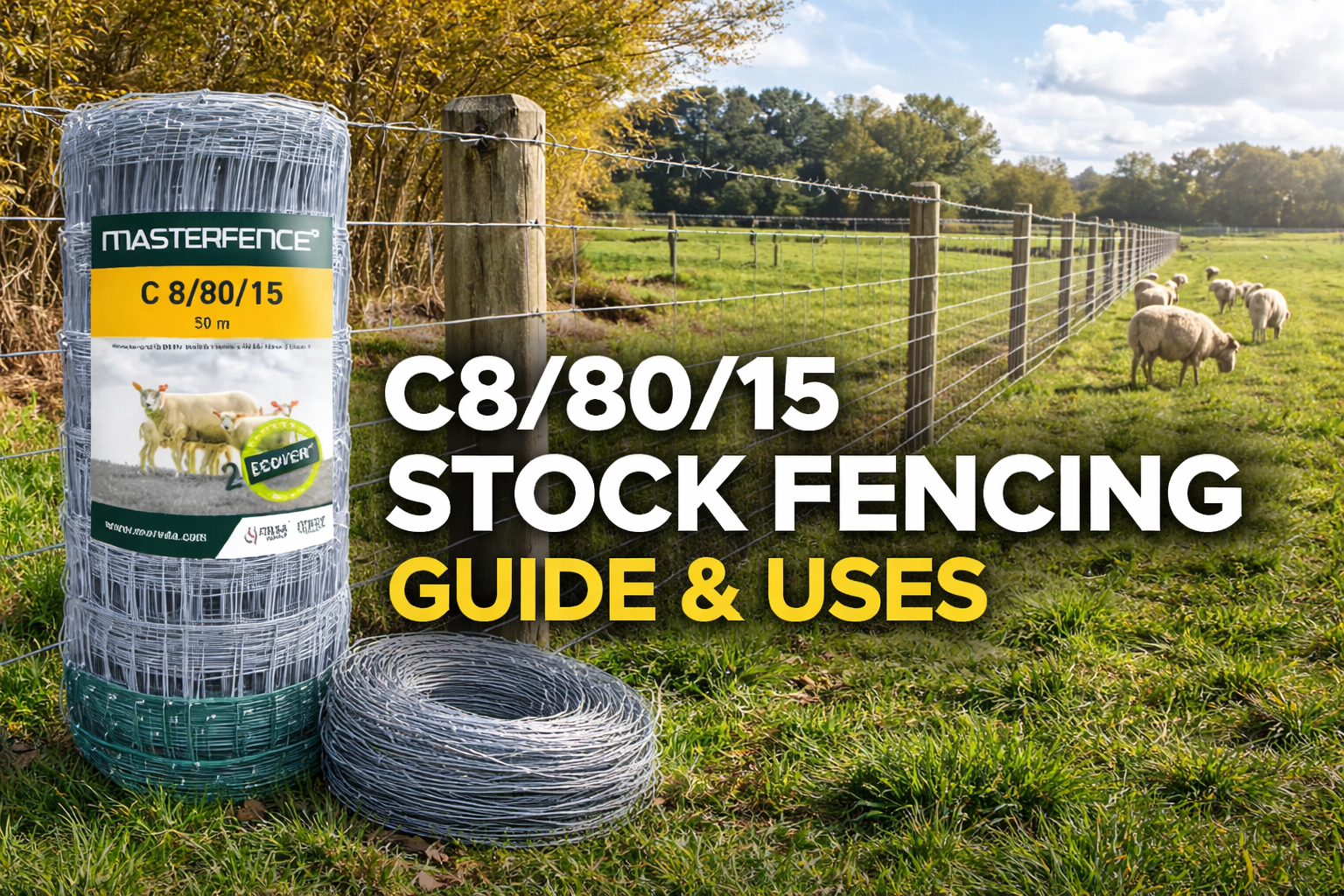
Stock fencing is one of the most practical ways to fence livestock, define field boundaries, and manage paddocks. In this guide we’ll break down what C8/80/15 means, where it works best, when to pair it with barbed wire, and a quick rule-of-thumb calculator to estimate quantities.
What does C8/80/15 mean?
The code C8/80/15 is a quick way to describe the fencing layout:
- 8 = number of horizontal wires (line wires)
- 80 = fence height (approximately 80cm / 0.8m)
- 15 = vertical spacing between the stay wires (approximately 15cm / 150mm)
C8/80/15 uses a graduated mesh (tighter at the bottom, wider towards the top) to help prevent smaller animals pushing through low gaps, while staying strong and stable across the full height.
Shop the product here: C8/80/15 Stock Fencing – Livestock & Agricultural Fencing (available in 50m and 100m roll options).
Where C8/80/15 stock fencing is commonly used
1) Sheep fencing & general livestock control
C8/80/15 is widely used for sheep and general livestock fencing where you want a strong, reliable barrier that’s quick to install over long runs. The smaller mesh at the bottom helps reduce issues with smaller animals squeezing through low gaps.
2) Agricultural field boundaries
Ideal for field and boundary fencing, especially where you need a long, continuous fence line. Stock fencing is often paired with timber posts and proper straining to keep the fence line tight and straight.
3) Paddocks, smallholdings & rural perimeter runs
For paddocks and smallholdings, C8/80/15 is a practical choice for day-to-day stock management. If you’re fencing more “energetic” animals (or you have pressure points like gateways, corners, or regular leaning), you may want to strengthen the build with additional line wires above, or combine it with barbed wire or electric.
Browse related ranges: Agricultural Fencing | Agricultural Wire & Barb | Fence Posts
When to pair stock fencing with barbed wire
Adding barbed wire is a common upgrade where you need extra discouragement against leaning, pushing, or climbing. It’s often installed above the stock fence (and sometimes on the livestock side, depending on your setup).
Use stock fencing + barbed wire when:
- Cattle (or larger animals) are leaning over the fence to graze the other side
- You need to increase the effective fence height without changing the mesh fencing
- You want extra perimeter security on a boundary line
- You have high-pressure areas (near gateways, corners, water troughs, feeding points)
If you need barbed wire: Galvanised Barbed Wire – 200m Roll
Installation basics (what actually makes stock fencing last)
Stock fencing performs best when the structure behind it is right. The mesh is only as good as the posts, strainers, and tensioning.
Key components
- Strainers / end posts at ends, corners, and direction changes (this is what holds tension)
- Intermediate posts to keep the fence line supported
- Fixings like fencing staples or clips to secure the wire to timber posts
- Correct tensioning to keep the fence upright and reduce sagging over time
Useful links: Fence Posts | Fixings & Postmix | Galvanised Staples
Quick rule-of-thumb “calculator” (fence rolls, posts, and fixings)
This isn’t a full fencing calculator—just a fast planning rule to stop you under-ordering. Always allow extra for corners, terrain, and tying-off.
1) How many rolls of C8/80/15 do I need?
- Rolls needed = (Total fence length in metres) ÷ (Roll length) → round up
- Wern-Wood options: 50m or 100m rolls
- Add 5–10% extra allowance for awkward runs, dips, corners, and tying-off
Example: 180m run using 50m rolls → 180 ÷ 50 = 3.6 → 4 rolls (then consider a little extra allowance).
2) Rough post quantities (typical spacing)
- Intermediate posts are commonly spaced around 2–3m apart for stock fencing runs
- Intermediate post count ≈ (Fence length ÷ spacing) + 1 → round up
- Always plan additional posts for ends, corners, and gateways (strain points)
Example: 180m run at 2.5m spacing → 180 ÷ 2.5 = 72 → +1 ≈ 73 posts (plus strainers/corners/gate posts).
3) Fixings: staples / clips
- As a rough guide, plan for multiple fixings per post depending on the fence height and your method
- For timber posts, use galvanised staples sized to suit the wire and post
Need staples: Galvanised Staples (multiple sizes)
Summary: when C8/80/15 is the right choice
- Great all-round option for sheep/livestock containment, boundaries, and paddocks
- Graduated mesh helps improve control near the ground
- For higher pressure fencing, pair with barbed wire above the fence line
- Proper strainers + tensioning is what keeps the fence performing long term
Ready to fence? Start here: C8/80/15 Stock Fencing – Livestock & Agricultural Fencing