Most People Count Fence Panels — Then Forget the Final Post
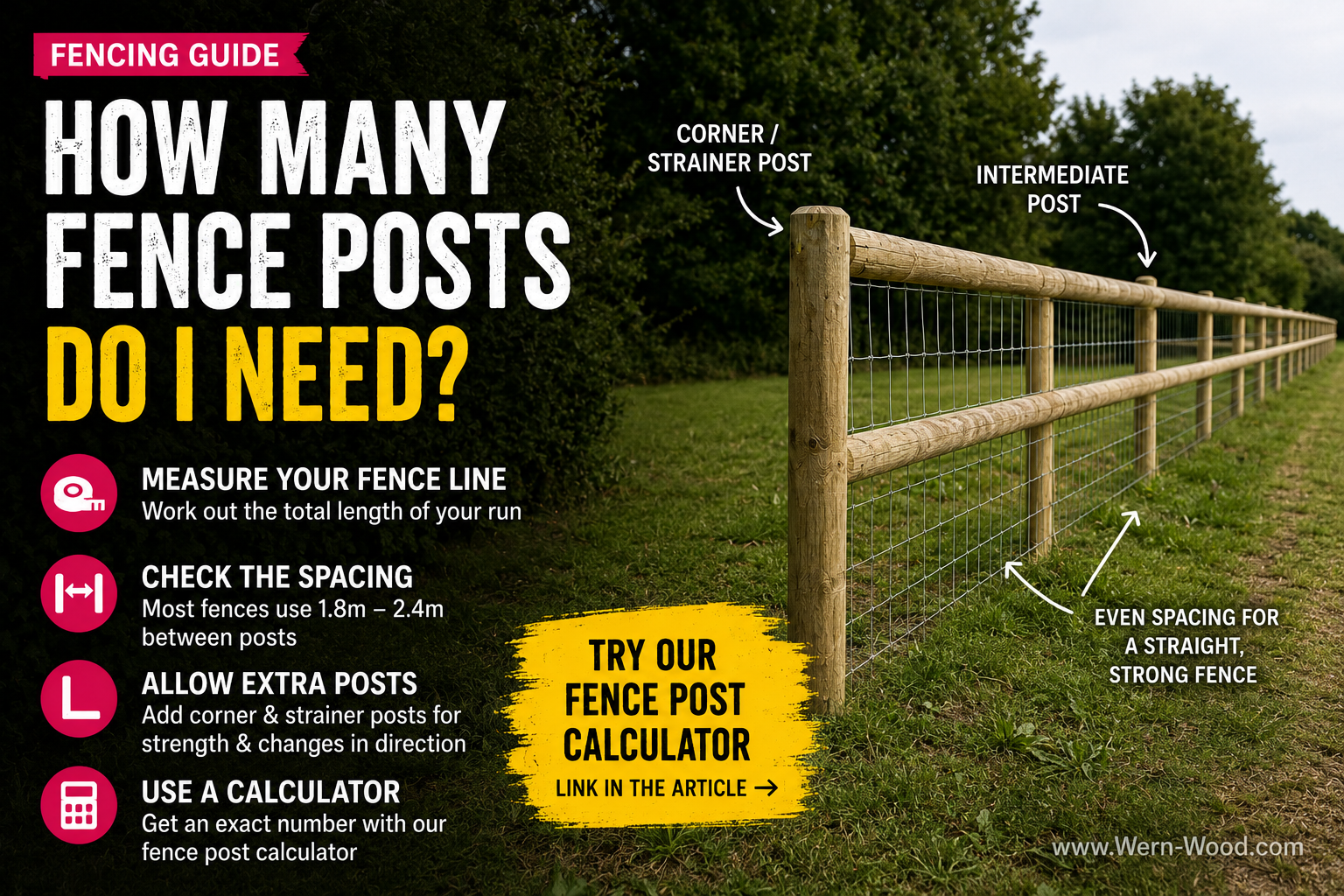
To work out how many fence posts you need, divide the total fence length by the bay width, round up to get the number of bays, then add one extra post. For example, a 10 metre fence using 1.83 metre wide bays gives 6 bays, so you need 7 posts. The extra post matters because a straight fence run needs a post at both ends, not just between each panel.
Fence post calculations look simple until you are halfway through the job and one post short. The mistake is nearly always the same: counting the spaces between posts instead of the posts themselves.
If your fence has six panels or six bays, it does not need six posts. It needs seven. One at the start, one at the end, and one between each bay.
The fence post formula
For a straight fence run, use this formula:
- Fence length ÷ bay width
- Round up
- Add 1 post
So if your fence run is 10m long and your bay width is 1.83m:
- 10 ÷ 1.83 = 5.46
- Round up to 6 bays
- Add 1 final post
- Total = 7 fence posts
That round-up matters because you cannot build 5.46 full bays. You either need to cut down the final bay, adjust the layout properly, or use a different bay width.
Why 1.83m matters for 6ft fence panels
Most standard UK fence panels are described as 6ft wide, which is approximately 1.83m. That is why 1.83m is a useful default spacing for panel fencing.
But do not treat 1.83m as a magic number for every fence. It depends on the product. A panel fence, featheredge fence, closeboard run or custom rail-and-board fence may need a different layout.
Before setting posts, check the actual panel, rail or bay width you are using. Product dimensions, concrete post slot depth, timber post fixing method and site cutting can all affect final spacing.
Common fence post spacing examples
These examples use a 1.83m bay width, which is commonly used for 6ft fence panels. Always check your actual product before ordering or digging.
| Fence length | Bays at 1.83m spacing | Fence posts needed |
|---|---|---|
| 5m | 3 bays | 4 posts |
| 10m | 6 bays | 7 posts |
| 15m | 9 bays | 10 posts |
| 20m | 11 bays | 12 posts |
| 25m | 14 bays | 15 posts |
When the calculator is not enough
The calculator works for a straight run, but real gardens are not always one straight line. Corners, ends, gates, slopes and changes of direction need more thought.
Use the calculator for each straight section, then check the full layout before ordering.
| Fence feature | What changes | What to check |
|---|---|---|
| Straight run | Use bays plus one post. | Check total length and bay width. |
| Corner | Needs a proper corner post or post arrangement. | Do not double-count or miss the turning point. |
| End post | Finishes the run and takes end load. | Make sure the final post is included. |
| Gate opening | Gate posts may need to be stronger than ordinary intermediate posts. | Allow for gate width, hinges, latch and post size. |
| Slope or uneven ground | May affect panel choice, stepping or cutting. | Plan the finished line before ordering. |
Do not stretch the spacing to save a post
One of the worst fixes for under-ordering is stretching the bay spacing to make the posts you have cover the distance. It might seem close enough on paper, but it can create weak bays, awkward fixing points and poor panel support.
Fence posts are the structure of the fence. Panels, rails, gravel boards and fixings all rely on the posts being in the right place. If the spacing is wrong, the rest of the job becomes harder.
If the calculation says you need another post, buy the post. It is cheaper than forcing the spacing, cutting corners, setting concrete twice or coming back later to fix a leaning bay.
What type of fence posts do you need?
Once you know how many posts you need, the next question is which type of post suits the job. Wern-Wood stocks timber fence posts, concrete fence posts, agricultural posts, gate posts and post supports for different fencing projects. :contentReference[oaicite:1]{index=1}
| Post type | Best suited to | What to think about |
|---|---|---|
| Timber fence posts | Garden fencing, featheredge fencing and general outdoor projects. | Choose suitable size, length and treatment for the job. |
| Concrete fence posts | Panel fencing, long-term boundary fencing and low-maintenance installs. | Alignment matters before concrete or postmix sets. |
| End and corner posts | Finishing runs and turning corners. | Do not treat every post as an intermediate post. |
| Gate posts | Garden gates, driveway gates and heavier access points. | Gate weight, hinge position and ground conditions matter. |
| Agricultural posts | Stock fencing, paddocks and rural boundaries. | Plan strainers, wire and access points together. |
Browse Fence Posts once your post count is clear.
Do not forget postmix, gravel boards and fixings
A post count is not the full materials list. If you are building a fence properly, you may also need postmix, fence screws, nails, bolts, brackets, clips, gravel boards, rails or panels depending on the fence type.
Wern-Wood’s Postmix & Fixings range includes postmix, screws, nails, bolts, brackets and other fixings commonly used for fence and gate installations. :contentReference[oaicite:2]{index=2} Gravel boards are also used to protect fence panels from ground contact and splash-back at the base of the fence. :contentReference[oaicite:3]{index=3}
- Postmix secures posts in the ground.
- Fixings hold panels, rails, boards and gates properly.
- Gravel boards help protect the bottom of the fence from wet ground.
- Rails or panels should match the post spacing and fence style.
For a complete fencing order, check Postmix & Fence Fixings, Gravel Boards and the wider Fencing, Decking & Landscaping range.
Common fence post calculation mistakes
- Counting panels instead of posts — six bays need seven posts.
- Forgetting the final post — every straight run needs a post at both ends.
- Not rounding up — partial bays still need a full post position.
- Using 1.83m without checking the product — not every fence system uses the same spacing.
- Stretching the spacing — this can weaken the fence and make panels harder to fit.
- Forgetting corners and gates — these may need different posts or extra hardware.
- Only ordering posts — most fencing jobs also need postmix, fixings and possibly gravel boards.
Before you order fence posts
Before adding posts to your basket, check the full job:
- Total fence length — measure each straight run separately.
- Bay width — use the actual panel or spacing you are working to.
- Number of corners — corners may need specific posts.
- Gate openings — gate posts may need to be larger or stronger.
- Post length — allow enough post below ground.
- Ground conditions — soft or exposed ground may need more care.
- Postmix and fixings — order the full system, not just the posts.
FAQs
How many fence posts do I need?
For a straight run, divide the fence length by the bay width, round up, then add one. For example, a 10m fence with 1.83m bays gives 6 bays, so you need 7 posts.
Why do I add one extra fence post?
The bays are the gaps between posts. A straight run needs a post at the start and a post at the end, so the number of posts is always one more than the number of bays.
How far apart should fence posts be?
It depends on the fence system. Standard 6ft fence panels are approximately 1.83m wide, so 1.83m is a common spacing for panel fencing. Other fencing systems may use different spacing.
How many posts do I need for 10 metres of fencing?
Using 1.83m bay spacing, 10m divided by 1.83m gives 5.46 bays. Round up to 6 bays, then add one final post. That means you need 7 posts.
Do corners need extra fence posts?
Corners need planning carefully. A corner may need a specific corner post or a stronger post arrangement depending on the fence type. Measure each straight run separately and check the corner before ordering.
Do gates change the number of posts?
Yes. Gate openings usually need gate posts, and these may be larger or stronger than standard intermediate posts. Allow for the gate width, hinges, latch and finished opening.
What else do I need besides fence posts?
Most fencing jobs also need postmix, fixings, panels or rails, gravel boards and possibly gate hardware. Order the full fencing system together so the post count matches the rest of the materials.
Summary: count the gaps, then add the final post
The simple rule is: divide the fence length by the bay width, round up, then add one post.
That final post is the bit people forget. It is also the difference between a clean fence run and a job that gets stretched, improvised or delayed halfway through.
Measure the run, use the actual bay width, check corners and gates, then order posts, postmix, fixings and gravel boards together.
Worked out your fence post quantity?
Now build the full materials list: fence posts, postmix, fixings, gravel boards, rails or panels. Get the full fence planned before you start digging.
Shop Fence Posts → Order online or collect from our Briton Ferry yard. Yes, we deliver.This calculator is a practical guide for straight fence runs. Corners, gates, slopes, ground conditions, panel type, post type and installation method can change the final materials list. Always measure the actual site and product before setting posts.