The Timber Might Be Right — But the Wrong Screw Can Still Ruin the Job
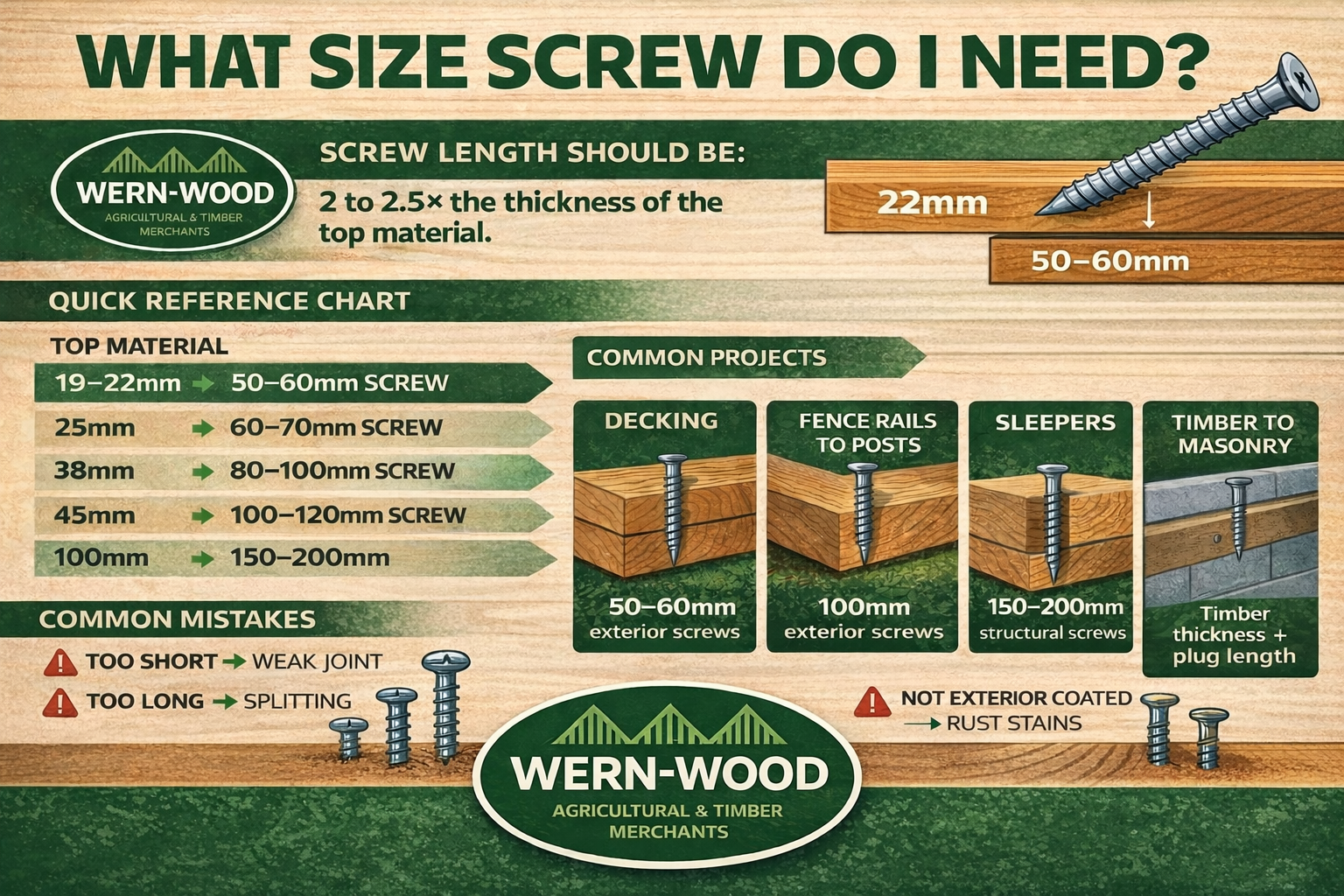
For timber-to-timber fixing, a useful starting rule is to choose a screw around 2 to 2.5 times the thickness of the top piece of timber. For example, a 22mm board usually points towards a 50–60mm screw, while a 45mm rail may need something around 90–120mm depending on the job. Screw length is only half the decision: outdoor timber also needs the right coating, and structural fixings should follow manufacturer guidance or the project specification.
If there is one thing people consistently guess on timber jobs, it is screw length. They will measure the boards, check the levels, choose the timber, and then grab a random box of screws because “that looks about right”.
Sometimes that works. Quite often it does not.
A screw that is too short will not bite properly into the second piece of timber. A screw that is too long can split the timber, poke through the back, or waste money without adding strength. A screw with the wrong coating can rust outdoors, stain the timber and weaken the fixing over time.
The simple screw length rule
For normal timber-to-timber fixing, use this as your starting point:
- Measure the top timber
- Multiply by 2 to 2.5
- Round to a common screw length
- Check the screw coating
- Pre-drill where needed
- Use specified fixings for structural work
The idea is simple. The screw needs to pass cleanly through the first piece and get enough bite into the second piece to hold the joint properly. If it barely catches the timber underneath, the fixing can loosen as the timber moves.
Timber expands, contracts, dries and swells. Outdoor timber sees even more movement because of rain, sun, damp and seasonal changes. The fixing has to be long enough and suitable enough to cope with that movement.
Screw length examples for common timber jobs
These are practical starting points, not a structural design table. Always check the product, joint and screw manufacturer guidance where the connection matters.
| Top timber thickness | 2× to 2.5× range | Typical use |
|---|---|---|
| 12mm | 25–30mm | Thin boards, trims and light internal fixing. |
| 18mm | 40–50mm | Sheet materials, boards and general joinery. |
| 22mm | 50–60mm | Featheredge boards, cladding boards and some decking boards. |
| 28mm | 60–70mm | Heavier decking boards or thicker external boards. |
| 38mm | 80–100mm | Fence rails, framing and thicker timber-to-timber fixing. |
| 45mm | 90–120mm | Fence rails, framing timbers and heavier outdoor connections. |
| 100mm | 150–200mm+ | Sleepers and heavy landscaping timber, depending on the joint. |
If the screw feels like it is only just catching, it probably is. Do not let the fixing be the cheapest and weakest part of a timber job you have already spent money on.
What size screws for sleepers?
Sleepers are where fixings are often undersized. Landscaping sleepers are heavy, and once they are stacked into raised beds, retaining edges or garden structures, they can move with weather and ground conditions.
For sleeper-to-sleeper fixing, 150–200mm heavy-duty landscaping or structural timber screws are a common practical range, depending on the sleeper thickness and the joint. A 100mm sleeper can point towards 200mm under the 2× rule, but lighter-duty layouts may use shorter heavy-duty screws where the connection is not doing the same work.
Do not use ordinary short woodscrews and expect them to behave like structural landscaping screws. For sleepers, the screw diameter, head type, coating and pull-down strength matter as well as length.
For landscaping projects, browse Garden Sleepers alongside suitable fixings from Screws, Nails & Fixings.
What size screws for fence rails and featheredge?
Fence rails are commonly around 38–45mm thick, so many fence rail fixings fall into the 80–120mm range depending on the rail, post and fixing method.
Featheredge boards are thinner. A 22mm board usually points towards a 50–60mm exterior screw or suitable ring shank nail, depending on the chosen fixing method and fence design.
This is where coating matters. Fencing timber lives outside, and treated timber can be harsh on the wrong fixings. Use exterior-rated, galvanised, coated or stainless fixings suitable for treated timber and the environment.
For fencing jobs, browse Featheredge Boards, Fence Rails, Fence Posts and Screws, Nails & Fixings together.
What size screws for decking?
Decking screws need to be long enough to hold the deck board down into the joist, but not so long that you are simply over-fixing with unnecessary length.
For many timber decking boards, 50–70mm exterior decking screws are a common range, depending on board thickness. For example, decking screw guides commonly pair 19–22mm boards with around 50mm screws and 25–28mm boards with around 60mm screws.
Decking also needs the right screw type. Decking screws are designed for exterior use and treated timber. Ordinary internal screws outside are a false economy.
Browse Decking Boards and Decking Screws together so the board and fixing match.
Fixing timber to masonry is different
The 2× to 2.5× timber rule does not apply when fixing timber to brick, block or concrete.
For masonry fixing, the screw length depends on the timber thickness, plug or anchor embedment, hole depth and manufacturer guidance. A simple example: if you are fixing a 25mm batten and the plug needs 50mm of embedment, you are already looking at at least 75mm before allowing for any specific fixing requirements.
Do not guess masonry fixings from timber screw rules. Use the plug, frame fixing, masonry screw or anchor guidance for the actual wall material, load and fixing depth.
Can screws be too long?
Yes. Longer is not automatically better.
An over-long screw can split timber, especially near ends, edges or in hardwood. It can poke through the back of the second piece, clash with another fixing, or simply cost more without improving the joint.
Correct length is better than maximum length. The screw should suit the joint, not just look impressive in the box.
Do you need to pre-drill?
Sometimes, yes. Pre-drilling is especially useful when working near board ends, close to edges, with hardwood, with thick structural screws, or where a neat finish matters.
Some modern timber screws are designed to reduce splitting or avoid pre-drilling in many situations, but that does not mean pre-drilling is never needed. Hardwood decking guidance often recommends pre-drilling to avoid splits, tears and fixing problems.
- Pre-drill near board ends to reduce splitting.
- Pre-drill hardwoods unless the fixing manufacturer says otherwise.
- Pre-drill for large-diameter screws where the timber may split.
- Use countersinking where needed for a clean flush finish.
Exterior vs interior screws
If the timber project lives outdoors, use fixings designed for outdoor use. This applies to fencing, decking, sleepers, cladding, pergolas and garden structures.
Metal fixings used outdoors need to resist corrosion. Treated timber, moisture, tannins, coastal conditions and pollution can all affect fixing performance. A technical guide from the Timber Decking and Cladding Association notes that metal fixings capable of performing in an outdoor environment should be used, because unseen fixing deterioration can compromise the safety of the structure.
| Fixing type | Best suited to | Watch out for |
|---|---|---|
| Internal woodscrews | Dry indoor joinery and light internal timber work. | Do not use ordinary internal screws outdoors. |
| Exterior coated screws | Fencing, decking and outdoor treated timber where compatible. | Check coating suitability for treated timber and exposure. |
| Galvanised fixings | Many general outdoor timber applications. | Not every galvanised product suits every exposure or timber treatment. |
| Stainless steel screws | Higher corrosion-risk areas, visible fixings and some hardwood/outdoor applications. | More expensive, but often cleaner for exposed or aggressive environments. |
| Structural timber screws | Sleepers, joists, landscaping, frames and heavy-duty connections. | Use the specified product, length, diameter and fixing pattern. |
Common screw length mistakes
- Guessing from the box — measure the timber first.
- Using screws that only just catch — the fixing needs real bite into the second piece.
- Going too long — over-long screws can split timber or poke through.
- Using interior screws outdoors — rust, staining and failure can follow.
- Forgetting treated timber compatibility — coatings matter outdoors.
- Using the timber rule for masonry — plugs and anchors have their own guidance.
- Skipping pre-drilling near edges — especially in hardwood or dry timber.
- Using ordinary screws for structural jobs — heavy-duty connections need specified fixings.
Before you order screws
Before adding fixings to the basket, check the full job:
- What thickness is the top timber?
- What is the second piece of timber?
- Is the job indoor, outdoor, damp, treated, hardwood or masonry?
- Is the fixing structural or just holding trim?
- Do you need coated, galvanised or stainless fixings?
- Will you need to pre-drill or countersink?
- Are screws the right fixing, or would nails, bolts, brackets or anchors be better?
For general fixings, start with Screws, Nails & Fixings. For outdoor decking jobs, go straight to Decking Screws. For fencing builds, check Postmix & Fence Fixings as well.
FAQs
What length screw do I need for timber?
For simple timber-to-timber fixing, a useful starting point is 2 to 2.5 times the thickness of the top piece of timber. For example, 22mm timber usually points towards around 50–60mm screws.
How much screw should go into the second piece of timber?
The screw needs enough bite into the second piece to hold the joint. A common guide is to make sure the screw enters a meaningful depth into the lower timber, rather than only just catching it. For structural work, follow the fixing manufacturer or design specification.
What size screws for decking boards?
Many timber decking boards use screws in the 50–70mm range depending on board thickness. Always use exterior decking screws suitable for treated outdoor timber.
What size screws for featheredge boards?
For a 22mm featheredge board, a 50–60mm exterior screw is a practical starting range when fixing to rails. Some fencing systems may use nails instead, so match the fixing to the fence design.
What size screws for sleepers?
For sleeper-to-sleeper fixing, heavy-duty landscaping or structural timber screws around 150–200mm are commonly used depending on the sleeper thickness and joint. Do not rely on ordinary short woodscrews for heavy sleepers.
Can I use indoor screws outside?
No. Outdoor timber needs exterior-rated fixings. Use suitable coated, galvanised or stainless screws depending on the timber, treatment and exposure.
Do I need stainless steel screws?
Not always. Stainless steel is useful for higher corrosion-risk situations, visible outdoor fixings, some hardwoods and harsher environments. For many general outdoor jobs, suitable coated or galvanised fixings may be enough. Check product compatibility.
Do I need to pre-drill timber screws?
Pre-drilling is sensible near edges, near ends, in hardwood, with larger screws, or where a neat finish matters. Some screws are designed to reduce the need for pilot holes, but the timber and joint still decide.
Summary: length, coating and job all matter
Screw length does not need to be guesswork. For timber-to-timber fixing, start with 2 to 2.5 times the thickness of the top piece of timber, then round to a common screw size.
But do not stop there. Check whether the job is internal, external, treated, hardwood, masonry or structural. The wrong coating or screw type can cause just as many problems as the wrong length.
The timber does the visible work. The fixings hold the job together. Choose both properly.
Choosing fixings for a timber project?
Match the screw length, coating and fixing type to the timber and the job. Browse screws, nails, decking screws, postmix and timber fixings before you start building.
Shop Screws, Nails & Fixings → Order online or collect from our Briton Ferry yard. Yes, we deliver.Sources checked: Wern-Wood live sitemap and fixings categories; Screwfix screw buying guidance; SPAX decking screw guidance; Timber Decking and Cladding Association metal fixings guidance; current Wern-Wood screw length article. This article is general fixing guidance only. For structural connections, load-bearing work, engineered timber, masonry anchors, safety-critical fixings or manufacturer-specific systems, follow the fixing manufacturer, drawings, engineer specification or relevant competent advice.